


One of the ways many people interact with local government is when something new is proposed next door. Land use regulations and the legal system give differing degrees of tools for them to challenge what their neighbors might want to do.
When a glamping resort was proposed in Greene County, several nearby residents urged the Planning Commission and the Board of Supervisors to deny a special use permit (SUP) that would authorize tourist lodging.
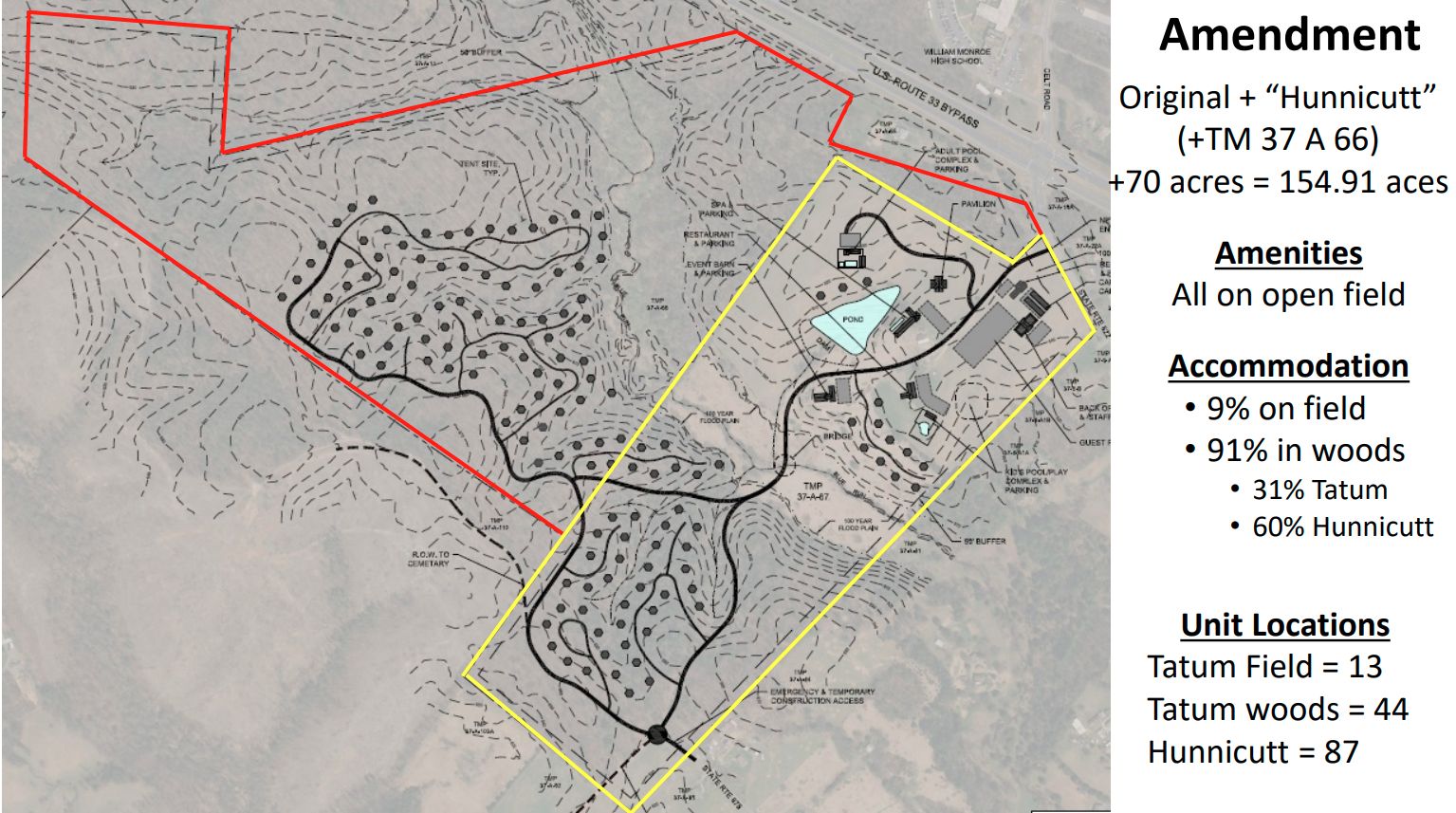
Property Owner Kenneth Tatum and Crimson Rock LLC originally sought to develop 85 acres with 144 lodging units, a spa, a restaurant, an event barn and administrative buildings under the name Sojourner Glamping Company. In 2021, they hired a company called Mangum Economics to conduct an impact study.
The developers applied for rezoning in 2022 that would redesignate the property from residential to agricultural. Tourist lodging is not allowed on land zoned for residential use but can be put on agricultural land with a special use permit.
The Planning Commission recommended approval after a public hearing in June 2022 and the Board of Supervisors followed suit with their okay later that month. Planning Director Jim Frydl, also Greene’s zoning administrator, determined that the project counted as tourist lodging.
A group of plaintiffs could have appealed that decision straight to the Board of Supervisors or the Board of Zoning Appeals but instead went straight to the circuit court to challenge Frydl’s determination and argued the county did not perform its own independent impact study. The zoning decision itself was not challenged.
The circuit court upheld Frydl’s determination in part because the plaintiffs had not attempted to handle the matter at the county level first. They could have appealed to either the Board of Supervisors or the Board of Zoning Appeals but chose the judicial route.
After the plaintiffs appealed, the developer and the Board asked the Court of Appeals to consider that a second special use permit had been granted on October 10, 2023 for a project that also included an additional 80 acres of land. That reduced the overall density of the resort. Supervisors’ vote was 3-1.
Greene County and Sojourner asked the Court of Appeals to determine that the appeal was moot because it was based on a first permit that was not being implemented. Moot is a legal term that means an argument no longer has any practical value.
“Crimson Rock could develop the Project on the Property irrespective of the existence or validity of the first SUP,” reads the conclusion of the eight page opinion written by Judge Jean Harrison Clements dated October 7, 2025. “Therefore, we find that the first SUP no longer controls the use and development of the Property, so the controversy over the first SUP has become moot.”
Ground has not yet broken for Sojourner Glamping. According to Greene County’s August 2025 Community Development report, a site plan for ten units and an event space is currently under review.
Before you go: The time to write and conduct research for this article is covered by paid subscribers to Charlottesville Community Engagement. In fact, this particular installment comes from the October 27, 2025 edition of the program. To ensure this research can be sustained, please consider becoming a paid subscriber or contributing monthly through Patreon.
Discover more from Information Charlottesville
Subscribe to get the latest posts sent to your email.


