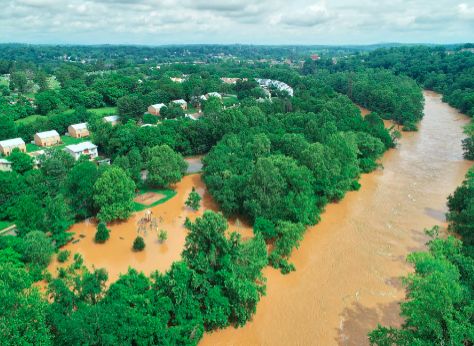
For the past eight years, the Albemarle County Board of Supervisors has been in support of efforts to monitor greenhouse gas emissions as part of an international bid to keep global temperatures from rising. For six years, though, a different set of elected officials opted out of the program.
On September 17, 2025, the six elected officials got a briefing from staff on county and regional efforts to reduce emissions and adapt to a world of higher temperatures and more volatile storms. They were also briefed on how staff plans to use $300,000 the Board dedicated to the issue at the end of the FY2026 budget process as I reported at the time.
Resources:
But first, some recent history.
Recent history
In June 1998, local leaders signed a document called the Sustainability Accords, a series of statements intended to solidify the work of several environmental groups working in the area. While climate action itself was not mentioned, the document called for the development of “attractive and economical transportation alternatives to single occupancy vehicle use” and called for the promotion of “conserv[e]ation and efficient use of energy resources.”
In December 2007, Albemarle Supervisors voted to adopt a goal of reducing carbon emissions by 80 percent by the year 2050. At the time, Supervisor Ken Boyd voted for the “Cool Counties” initiative though he expressed concern about the potential impacts. (read a story I wrote then)
In the years that followed, a group called the Jefferson Area Tea Party raised concerns about both the resolution and the county’s membership in the International Council for Sustainability. The ICLEI group provided resources to measure greenhouse gas reductions and Boyd sought to end participation
“We are being infiltrated in local government by an agenda that is set by this international organization,” Boyd said in early May 2011 as I reported at the time. “I think it’s now a cancer that is infiltrating our local government here.”
By that time, two other Republicans had joined the Board of Supervisors giving Boyd votes he needed to change direction. Democrat Lindsay Dorrier Jr. was a swing vote.
Lane Auditorium was packed on the night of June 8, 2011 with some in the crowd defending sustainability efforts and continued participation in efforts to reduce greenhouse gas emissions. Members of the Tea Party claimed that civil liberties were being threatened.
At the end of the meeting, Supervisors voted 4-2 to end participation in ICLEI as I reported at the time. Three months later, they ended participation in Cool Counties as reported in the Charlottesville Daily Progress.
However, the Republican majority would come to an end in 2013 after Democratic candidates defeated Duane Snow in the Samuel Miller District and Rodney Thomas in the Rio District.
Back on the job
In September 2017, Supervisors voted to adopt a resolution to “support local actions to reduce climate pollution.”
“In October 2019, the Board adopted greenhouse gas emissions reduction targets in line with the Paris Agreement,” said Jamie Powers, a county employee since 2023 who is now Albemarle’s Climate Program Manager. “The next year, October 2020, the board adopted the Climate Action Plan and stood up the Climate Action Program to implement that plan and help get the community’s emissions down in line with the board’s targets.”
The targets now call for a 45 percent in emissions reductions from 2008 levels by 2030 and to be carbon-free by 2050.
Powers said emissions continue to climb across the world and the effects of climate change are here now as a present crisis rather than one for the future to deal with.
“The impacts are generally going to be worse over time and increasingly unpredictable unless we can get global emissions under control,” Powers said. “And we do have a role to play locally.”
Albemarle’s reduction targets are in line with the Paris Agreement which set a framework to reduce emissions so that the increase in global warming could be kept below 2 degrees Celsius. The increase is now at 1.5 degrees.
Powers said climate change itself is not the underlying problem.
“It is a symptom of a set of problems,” Powers said. “This socioeconomic system that we have, it works exactly as designed and it brings us to a climate crisis and a biodiversity crisis and all these sorts of things. So if we are going to effectively address the climate crisis, we need to take a look at our systems and address things appropriately.”
The models used by Albemarle and other local governments are complex and conform to the Global Protocol for Community-Scale Greenhouse Gas Emission Inventories. These are put together by ICLEI and emissions come from many source sectors.
“The major sectors of emissions are transportation, stationary energy, and that includes solar,” said Greg Harper, Albemarle’s chief of environmental services. “That would be kind of like reducing that stationary energy. Ag force and land use is a smaller contributor and then waste as well.”

Albemarle resumed doing inventories in 2018 and Harper said emission levels dropped during COVID but increased for 2022. Data is about two years behind. Harper said reductions can be decreased many ways, such as if many groups can work together to reduce a metric known as “vehicle miles traveled.”
“We don’t want to stop activity in the county, obviously, but we want to shift people from driving a car by themselves to taking mass transportation, getting on their bicycle for smaller commutes,” Harper said.
Powers said Albemarle has been active in many ways to encourage reductions such as supporting home energy improvements, providing “climate action activity kits” through a nonprofit, installing electric vehicle chargers, and creation of the Energy Resource Hub.
Albemarle also provided several grants including $20,000 for the International Rescue Committee’s New Roots farming program to allow them to electrify equipment and improve their agricultural practices.
“If we break down some of the things that they were doing from their composting practice, we calculated that about 25 tons of carbon dioxide is sequestered by them using the composting practices,” Powers said. “About 5 tons of avoided emissions by removing synthetic fertilizers from their operations.”
All told, Powers said about 38 tons of carbon dioxide emissions were prevented.
Albemarle County is also collaborating with the City of Charlottesville and the University of Virginia on the Resilient Together initiative which seeks to create a resilience plan to adapt to a different weather pattern. That will come before the Planning Commission and the Board of Supervisors in early 2026.
FY2026 funding
Powers also outlined a recommendation of how Albemarle might put that $300,000 to use, as well as another $222,000 in carry over funds for climate action.
“The Board made it clear we wanted to emphasize projects that are going to get the most value in terms of emission reductions in FY26,” Powers said.

The Residential Energy Improvements line item is intended to assist property owners with lower incomes and that $237,000 does not include another $150,000 the county received through the federal Community Development Block Grant program.
“A lot of times, especially in low income households, energy is going out the window, literally,” Powers said. “And so how can we help those folks tighten up their envelopes so when they’re turning the AC or the heat on, it’s still staying in the home instead of heading out the window.”
The Local Energy Alliance Partnership (LEAP) and the Albemarle Housing Improvement Program (AHIP) are partners on that project. Powers said the goal will be to reach up to 50 homes, decreasing emissions classified as “stationary” energy. He estimates the return on investment will be about $3,000 per ton of emissions prevented.
Another $100,000 will be spent on energy efficiency in county-owned buildings.
“Most likely implementation looks like LED installation, LED fixture installation, likely at two different buildings,” Powers said. “If we transition the equivalent of the space of Northside Library to those fixtures, we would reduce again in that stationary energy category, one of those four categories by 0.03 at $700 per ton and annually that’d be a 143 ton reduction.”
Albemarle funded the Energy Resource Hub in FY2025 at the $100,000 level and an additional $63,000 for this year. This is a program that helps homeowners find rebates and other incentives.
Partners have not yet been found for the Climate Action Collaboration initiative.
Before you go: The time to write and conduct research for this article is covered by paid subscribers to Charlottesville Community Engagement. In fact, this particular installment comes from the September 30, 2025 edition of the program. To ensure this research can be sustained, please consider becoming a paid subscriber or contributing monthly through Patreon.
Discover more from Information Charlottesville
Subscribe to get the latest posts sent to your email.