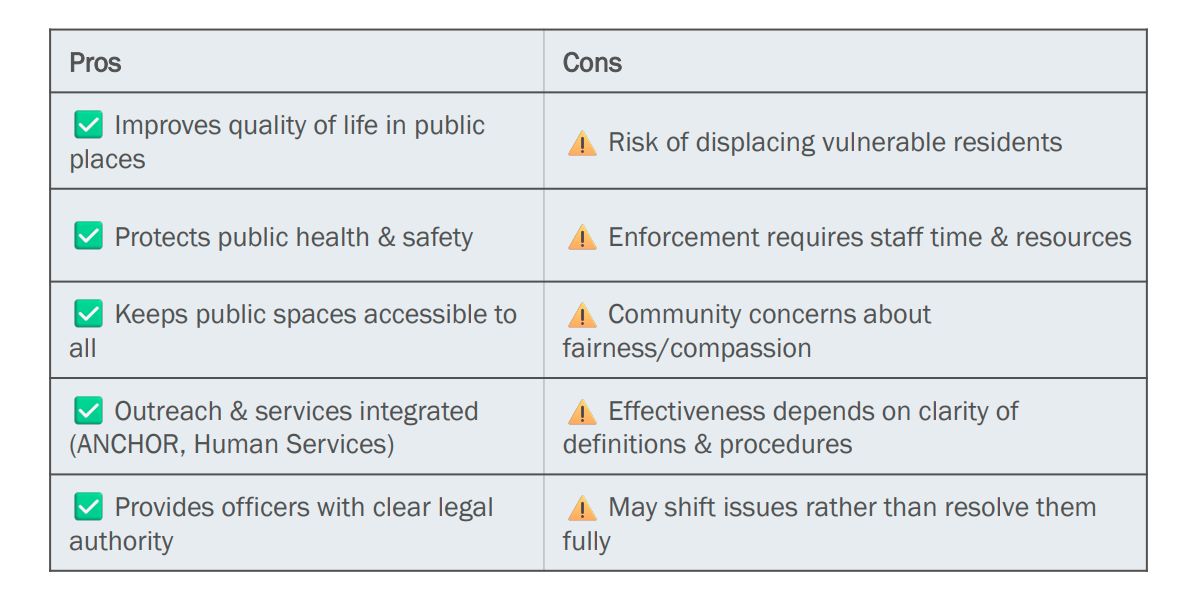
The Charlottesville City Council has tabled a proposal to make it a misdemeanor to camp on public property after a series of speakers expressed outrage at the idea.
“When I first heard about the ordinance to criminalize the homeless I was shocked, followed by absolute fury that continues to this day that you would even discuss an issue of making people who are suffering from a lack of shelter into criminals,” said Jeff Fogel at the beginning of the meeting. “It’s disgusting.”
The ordinance and accompanying protocol were developed after private talks this spring and summer between City Councilors and Charlottesville Police Chief Michael Kochis. The public first learned about the idea when the agenda for the September 2 meeting was published.

Fogel’s comments were met with fierce applause as were those of others against the proposal during the public comment period at the beginning of that meeting.
Those who expressed different opinions were booed, such as the director of the group Friends of Downtown Cville.
“I am here to speak in favor of the ordinance on camping on city property,” said Greer Achenbach before the crowd began to jeer.
The rules for City Council meetings prohibit the interruption of speakers and do not allow for others to address Council or a person speaking if they’ve not been recognized. Mayor Juandiego Wade appealed for calm, but Fogel and others tried to prevent Achenbach from being heard as she tried to explain her view.
“I represent many visitors and business owners who are afraid to speak in favor of this ordinance for fear they will be misrepresented in a way that affects their businesses and their families,” Achenbach said.
Achenbach said she would support an idea Fogel floated to create a designated camping area until a low-barrier shelter and other beds are constructed, but this should not be along the Downtown Mall.
There were no interruptions when people against the ordinance spoke, such as Shayla Washington. She’s the executive director of the Blue Ridge Coalition for the Homeless and said has been unhoused in her lifetime.
“And there were times when I would wake up in my car, which I was blessed to have, and there would be police headlights trained on my car and I would wake up thinking, ‘Oh my God, am I going to get arrested because I’m homeless, because I don’t have a place to live,’” Washington said.
Washington said there are many people across the country in the same situation, and switching from a compassionate approach to a draconian one is not the answer.
“Handing out class 4 misdemeanors to people who have no designated place to lay their head at night is cruel and inhumane,” Washington said.
On behalf of BRACH and other entities in what’s known as the “continuum of care,” Washington called upon Council to delay a vote on the ordinance until after the idea for a low-barrier shelter moves closer to reality.
Another request is the designation of three city-owned spaces where people can camp safely. These could have security details and a maximum number of residents but should also be on Charlottesville Area Transit routes.
Washington also called for formation of a working group to move forward with workable solutions.
Chief Kochis seeks to justify the ordinance
The draft ordinance was the last item on the meeting, Charlottesville Police Chief Michael Kochis began his presentation by stating that the idea for the ordinance came out of closed-door discussions with Councilors held on April 3.
So-called “two two one” meetings are when Councilors are briefed on potential items without a quorum being formed, meaning the public has no way of knowing what was discussed. No minutes are required.
“When we spoke during those two two ones, we talked about that ordinance being specific to their business district and the consensus was that if we were going to do such an ordinance and it should probably be more citywide and not just focused on one specific area,” Kochis said.

Kochis said he is aware of the need for more housing in the community and noted that Council has made several investments to help people who don’t have a place to stay. He said he’s met with many people who are unhoused.
“These are overwhelmingly great people who want the same basic dignity and stability we all do,” Kochis said. “Many have shared with me that they understand and even welcome reasonable rules. What we often see, however, is that a smaller number of unsafe and hazardous encampments create the greatest challenges and cause harm to others.”
Kochis said he was presenting a legal framework to take action when necessary. He said further two two one meetings were held on July 31 and August 1 when the elected officials were briefed on the ordinance’s progress. He said the proposed rules were to complement the city’s Affordable Housing Plan which called for $10 million a year to be spent.
“This ordinance does not replace our housing goals,” Kochis said. “This Council has been very clear on that. It exists alongside our housing initiatives and ultimately housing is the solution. The ordinance simply is about safety and health measures that we consistently see around large, specifically large encampments.”
In late June, Council approved a series of allocations from the FY2024 surplus that Charlottesville City Manager called “community interventions.” One of these was $1.2 million to hire a “clean team” to work on the Downtown Mall each morning. He said without this ordinance, there would be no legal way to remove people camping in vestibules and doorways.
Chief Kochis said the decision was ultimately up to City Council.
The executive director of the Virginia Coalition for Open Government said “two two one” meetings are legal but problematic.
“The public feels excluded because everything has been worked out ahead of time and they are given a done-deal,” said Megan Rhyne in an email.
Council deliberation
Murmurs from the audience permeated City Council Chambers as Council had the chance to ask questions in public.
City Councilor Michael Payne said he was concerned that the policy would be unconstitutional on equal protection grounds if the $250 fine could be waived for some individuals and not for others.
“Has there been any analysis of how this withholds constitutional muster?” Payne said. “I would imagine we will be met with a lawsuit.”
The draft ordinance was written by the City Attorney’s office.
“We’re talking about city property and our ability to regulate city property is broad and wide,” said City Attorney John Maddux. “And that is what we are doing here with this ordinance. I’m not speaking to the policy decision as yours, but as to the constitutionality of it. We have done our very best in our office to draft an ordinance that accords with the council’s goals and the requests coming from the police department.”
At this point, Fogel interrupted and asked who had called for the ordinance. Mayor Wade again was unsuccessful in restoring order so City Councilor Natalie Oschrin stepped in.
“We appreciate community input,” Oschrin said. “We have to run this meeting by Roberts Rules of Order.”

Payne said the existing status quo for encampments is for them to be removed if there are enough emails and complaints. In those cases, people just end up somewhere else.
“How does this change that situation?” Payne said. “I mean, it adds a layer of criminalization, potential criminalization on top of it. The fundamental issues. We can go out there with social services providers, but there’s no permanent supportive housing or overnight shelter to direct them to.”
Chief Kochis said this had been discussed at the two two one meetings and he knows that the ordinance is not a solution to the overall problem of homelessness. He also acknowledged that nonprofits that provide outreach to the unhoused were not consulted on this ordinance.
In addition to a July 22 executive order from the White House calling on an end to federal funding of “housing first” policies, the U.S. Supreme Court ruled in June 2024 that removing people from encampments did not violate the 8th Amendment’s prohibition on cruel and unusual punishment. (read the ruling)
Councilor Oschrin said the topic came up at Council’s recent retreat held on August 15 and August 16.
“At the council retreat, we all kind of said we’re ready to do something,” Oschrin said. “I’m not quite certain that this ordinance was the something because it is still putting that cart before the horse.”
Oschrin recommended tabling the ordinance until there was more progress toward establishment of a low-barrier shelter.
City Councilor Lloyd Snook said he also thought the ordinance was premature and he had said so in those two two one meetings.
“I thought that for us to move forward with an ordinance like this would require that we have a plan for where the people would go, where we want them to be,” Snook said. “And I don’t mean in the Donald Trump sense of jail or whatever, but in terms of the housing first attitude that the city has adopted and has tried to adopt and work on over the last few years.”
Snook said encampments can mean environmental damage such as an elevation of E. Coli bacteria in the Rivanna River due to a large presence of people living under Free Bridge. He said he would support the idea of a monitored space with portable bathrooms.
Vice Mayor Brian Pinkston said people who make complaints about the sanitary conditions and effects are not bad human beings.
“I don’t think that I’m a bad person because I would like that situation to be better,” Pinkston said.
Pinkston acknowledged his time on Council is almost over given his loss in the Democratic Primary on June 17. He said during his tenure, Council has made many investments to build more housing and adopted a zoning code to make it easier to build more residential units. When he was campaigning this spring, he talked to many people.
“I spoke with people all over the city, very, very liberal, progressive people throughout the whole city,” Pinkston said. “And what I have observed is that there’s a very deep cognitive dissonance within this city. People come tonight, they’ll email us with hundreds of emails. And I know that their hearts are in the right place. But when I go meet with people in their front doors, people do not want a shelter in their neighborhood.”
Two places have been identified but have not yet moved forward.
In early 2024, Council agreed to purchase 405 Levy Street from the Charlottesville Redevelopment and Housing Authority for just over $4 million. The original idea was for this to be considered as a location for a low-barrier shelter.
“This acquisition supports the City Manager’s commitment to homelessness intervention as it could become the site of a facility that serves to meet that need among others,” reads the staff report for the January 22, 2024 meeting.
In October 2024, Sanders told Council that one option would be to open a low-barrier shelter at the Salvation Army’s thrift store on Cherry Avenue. The budget for FY2026 includes a $250,000 payment to that organization for potential loss of revenue as well as a $500,000 in funds toward operations of such a facility.
Pinkston said he didn’t feel the Cherry Avenue location was suitable for the Fifeville neighborhood. Mayor Juandiego Wade said he does.
“No one wants a no or low barrier shelter,” Wade said. “And every place we have proposed it, we have gotten pushback. But I continue to support the location in Fifeville.”
Wade also said without a vibrant business community, the city will not have an economic base to support continued spending on housing and social services.
At the end of the discussion, Pinkston made a motion to table the ordinance, which means to eliminate further consideration. Councilor Oschrin made a second and the vote was unanimous.
Before then, Payne said a next step is to determine if the Cherry Avenue site will move forward.
“And then from there, you know, pick a location,” Payne said. “But it’s going to take years and millions of dollars and every budget cycle it’s going to require city council prioritizing that.”
Another topic that came up at the City Council retreat is the city’s ability to further increase taxes to pay for an ever-growing number of requests.
Before you go: The time to write and research of this article is covered by paid subscribers to Charlottesville Community Engagement. In fact, this particular installment comes from the September 3, 2025 edition of the program. To ensure this research can be sustained, please consider becoming a paid subscriber or contributing monthly through Patreon.
Discover more from Information Charlottesville
Subscribe to get the latest posts sent to your email.