There are just over two three weeks until party primaries in Virginia and all localities have one on the Democratic side to determine general election candidates for Attorney General and Lieutenant Governor. To learn more about the Democrats vying for Lieutenant Governor, go visit this story on the Virginia Political Newsletter.
In Charlottesville, there are three candidates vying for two Democratic nominations for City Council. No independent or Republican candidates have yet emerged, so this may be the only time voters get to have a choice this year.
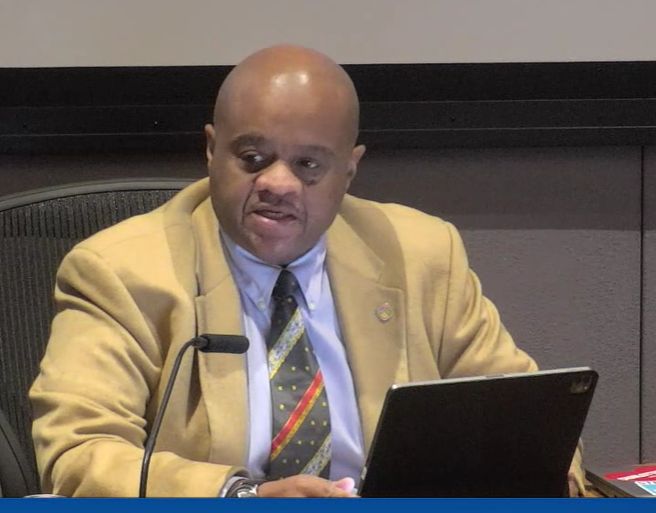
One way for people to learn about the candidates is a campaign forum. The Greenbrier Neighborhood Association had one on May 14 that offered one way to get to know Jen Fleisher, Brian Pinkston, and Juandiego Wade. I have a summary of some of what was said.
The Free Enterprise Forum had another on May 28 and Neil Williamson served as co-moderator.
“The goal of the City Council Democratic Primary Candidate Forum is to provide a venue for these candidates to speak about many issues,” Williamson said.
You can watch the whole event on YouTube below. At publication time, there have been over three dozen views!
There were six questions in all, but the event began with opening statements. The candidates’ speaking order was drawn from Neil’s hat and incumbent Juandiego Wade got to go first. He grew up in Richmond, graduated from Norfolk State University, and came to Charlottesville to attend the University of Virginia to get a master’s degree in Urban Environmental Planning.
“As part of my thesis. I work with the local NAACP on a national program and I got to meet many of the individuals, African Americans in this community, that shoulders that I now stand on,” Wade said.
Wade left for one year after graduating in 1990 but came back to the community to work as Albemarle County’s transportation planner.
“I got involved with this community at a very granular level and working with nonprofits, mentoring, and then ascending to being on board leadership,” Wade said. “I just learned so much about this community and really haven’t stopped since 1991, being involved and connected to this community, whether it’s serving on the school board for 16 years, being president of the United Way, I was really involved at different levels.”
Jen Fleisher is a public health program officer with the Blue Ridge Health District who said she led efforts to provide vaccines during the COVID-19 pandemic.
“My work now at the health department involves the community health needs assessment and the community health Improvement plan,” Fleisher said. “So that means I work every day to improve the health of our residents and the residents of the surrounding counties.”
Fleisher is also involved in local transportation planning as a public health professional and said that is key to providing better outcomes for housing and community health.
“I moved here 24 years ago, and I am a resident of the Belmont neighborhood, and I look forward to bringing the skills and expertise I’ve learned Being a regional leader to City Council,” Fleisher said.
Incumbent Brian Pinkson rounded out the opening statements. Like Wade, he also moved to the area to attend graduate school at UVA. He and his family lived in Greene County initially, but he moved to the city in 2015.
“My background and career has been in project management,” Pinkston said. “I like to say that project managers put people, resources, and ideas together to get things done. And that’s what I’ve done in my career. I work at UVA and Facilities Management.”
Pinkston said when he and Wade were elected in 2001, Charlottesville’s government was not functioning very well. He said the current City Council has helped turn things around and positioned the city to begin to get things done.
“We now have a really sharp, strong city manager and Sam Sanders, he’s doing great work,” Pinkston said. “He’s in turn hired a whole range of people that work for him. And we now have people in the City Manager’s office who really want to be in Charlottesville, and they’re making real contributions.”
The full video of the event has all of the questions but here are a selection of responses. Here’s part of the third question.
“Do you continue to support the commitment in Charlottesville’s affordable housing plan that Council spend at least 10 million [a year] on affordable housing construction and maintenance,” Williamson said. “Would you consent to a third party audit of how the money is being spent?”
Pinkston said he does support $10 million a year and is glad Council has been exceeding that amount in recent years. He understands that many have questions about how the money is being used.
“I’d be interested,” Pinkston said. “What I’m going to turn that into though, is a set of questions for our staff because I trust our staff to give us those kinds of data without having to bring in an outside consultant.”
Pinkston added that city investment is assisting the Piedmont Housing Alliance and the Charlottesville Redevelopment Authority develop new housing and preserve places to live. He said the city also needs to help make sure places that are currently affordable stay that way.
Wade said when he first got on Council, he wanted to know how the city has been using the Charlottesville Affordable Housing Fund that was created in 2007.
“They could not answer that question,” Wade said. “And that’s a lot of money to not knowing what was going on. Today, I feel highly confident that we can answer that with a high degree of accuracy because we have gotten our ducks in a row. We know we have the staff in place that we can answer that question.”
Fleisher said $10 million is the minimum amount of city investment required to begin to create more affordable units.
“The third party audit, I would have questions about that only [about] who’s paying that third party and what can we offer the transparency and the accountability that the audit is seeking ourselves,” Fleisher said. “Can our staff and our teams continue to track our progress with the fund in a way that all city members and residents know exactly where that money is being funded without paying for a third party consultant to do that work.”
In late 2021, City Council had been briefed on a study the firm HR&A conducted on the Charlottesville Affordable Housing Fund as part of the Cville Plans Together initiative. There’s a link to that report in the story I wrote back then.
The sixth question covered the state of relations between the University of Virginia and the City of Charlottesville.
“City Councilor Michael Payne recently wrote an article calling out UVA for being the ultimate recipient of the Federal Executive Institute, writing that the University’s acquisition would have an immense negative impact on the students in Charlottesville’s public schools and the town writ large,” said co-moderator Sean Tubbs. “Do you agree?”
Wade said he hears from many people in the Venable neighborhood about some of the immediate impacts such as a preponderance of red Solo cups littering the landscape. But he said if not for UVA, people like his family would not have settled in Charlottesville and called it home.
“We have a current administration that understands both the positive and the negative impacts that the University of Virginia has on the community,” Wade said. “And they’re trying to address with things like the Pathways program… and their support of building 1500 affordable units.”
Wade acknowledged that the recent decision related to the former Federal Executive Institute has angered many but the city has to move on and find other ways to work with UVA.
Fleisher agreed with Payne’s statement but said this provides a way for the community to put pressure on UVA to provide other avenues to support early childhood education.
“That does open other doors for UVA to be a better neighbor and to support the community outright and particularly the schools and the School Board by offering other opportunities for space and physical structures and facilities that might support that same intention that the School Board had with FEI,” Fleisher said.
Fleisher added that in her professional experience, she sees UVA Health working to be a better community partner.
Pinkston said he’s not in a position to be able to offer an opinion on Payne’s statement, but acknowledged his colleague has strong feelings. He said he was not privy to any of the discussions but pointed out that the UVA administration and the Board of Visitors may have different motivations. Pinkston said he knows about Payne’s desire to compel UVA to pay a “payment in lieu of taxes” to help cover the cost of local infrastructure.
“I don’t know the answer to those questions, but I think I always put it a little bit like a marriage,” Pinkston said. “You know, if you get into a point in a marriage where you’re arguing about every little thing as opposed to realizing you’ve got more in common together and you should make that work, then, then things are not heading in the right direction. And so what I want to do with the university is do everything I can to make sure we’re, you know, we’re, we’re moving together.”
As of June 2, 1,107 voters in Charlottesville have cast an early vote according to the Virginia Public Access Project.
Before you go: This story first went out over the airwaves as part of the radio version of this newsletter that airs on WTJU every Saturday morning at 6 a.m. Then it was part of the podcast version of the newsletter that went out on May 31, 2025. The print version went out in the June 2, 2025 edition of Charlottesville Community Engagement. Now it is posted here. It could be argued all of this should have happened at once, but there are also counter arguments to that point.
Discover more from Information Charlottesville
Subscribe to get the latest posts sent to your email.