Richardson, Ryan, and Sanders tackle economic growth, cooperation on solving problems
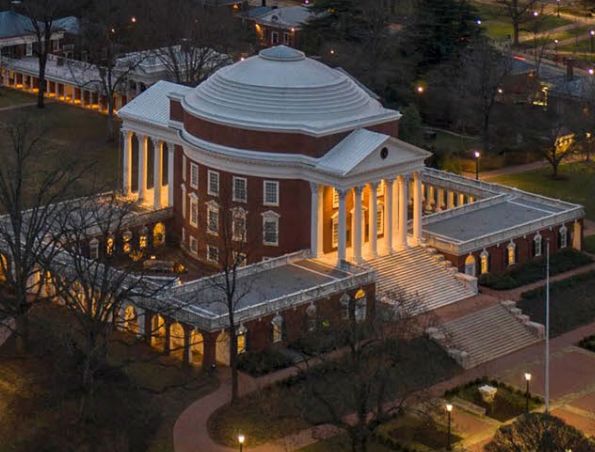
When the University of Virginia was chartered in 1819, Charlottesville’s future changed. The construction of the Academical Village meant that people from all over the country would come to this part of central Virginia for education. The growth of UVA has influenced the growth of Albemarle County and Charlottesville for over two hundred years.
In the fall of 2024, there were 25,944 undergraduate and graduate students at the University of Virginia according to the Office of Undergraduate Admissions. Nearly 8,000 degrees will be handed out in Final Exercises for the class of 2005. The Board of Visitors learned this past spring that UVA expects the number of undergraduate students to remain about the same but project some growth for graduates.
All of this plays out in a landscape influenced by the unique fact that cities and counties are separate political entities in Virginia. For many years, Charlottesville and other cities had the power to take land if they could demonstrate to a court they could do a better job of providing urban services.
The current boundaries of Albemarle County and Charlottesville have more or less been in place since 1963 when the last annexation took place. Population comparisons before then don’t really provide a meaningful point of reference, but beginning with 1970 we have some numbers to look at.
- The U.S. Census that year recorded 37,780 people in Albemarle County and 38,880 people in Charlottesville.
- Ten years later, Albemarle’s Census count jumped 47.7 percent to 55,783 while Charlottesville’s increased 2.7 percent to 39,916.
- The Weldon Cooper Center for Public Service at the University of Virginia produces the official estimates for the population of the Commonwealth of Virginia. They estimate there are 117,790 people in Albemarle and 51,743 in Charlottesville.
How do all of these pieces fit together? Answering that question is one of the missions of Charlottesville Community Engagement. The topic came up a lot at the 13th annual Tom Tom Festival, a four-day event in April that billed itself as being “about the future of our community.”
One of the events offers a chance to hear directly from the leaders of the area’s three major government entities. They gathered in the CODE Building’s Irving Theater for an event called “The Innovation Economy: A Coalitional Model for Building the Region’s Future.”
“This session is to look ahead, to look down the road three to five years or more,” said Congressman L.F. Payne in his role as moderator. “Today we will have an opportunity to hear from our leaders in terms of what are they thinking about tomorrow? Tomorrow, what are they thinking about three to five years down the road? What are they thinking about innovation?”
- Jeffrey Richardson has been Albemarle County Executive since October 2017.
- Sam Sanders has been Charlottesville City Manager since August 2023 and in city government since July 2021.
- Jim Ryan has been President of the University of Virginia since 2018. Ryan has presided over a large capital campaign that has seen the creation of the School of Data Science, the Karsh Institute of Democracy, and the Manning Institute of Biotechnology.
Payne said this area is recognized as a good place to start a business, but his first question asked about regional partnerships.
“So as we think about how this progresses, a question to begin with, and Jim, I’ll start with you on this is how are UVA and Albemarle county and Charlottesville looking at innovation as you plan and build this vibrant community for the future?” Payne asked.
Ryan responded that a university that wants to promote innovation has to be within an ecosystem that has three things.
“It’s a nice place to live,” Ryan said. “It is near or has in its community a research university, and there is capital to invest. Charlottesville has all three of those things.”

On the first item, Ryan said transportation systems need to be in place and there have to be good schools.
Richardson began by informing the audience that Albemarle’s growth area is about 36 square miles compared to the 10.4 square miles of Charlottesville. He said the county builds off the city’s imprint and economic development is playing a big role in the 21st century.
“It’s a regional economy and we are beginning at the Albemarle county level with our economic development work to lean in hard to that,” Richardson said. “And with our recent purchase of 462 acres in the Rio/29 corridor around Rivanna Station, which employs 3,000 employees, we have gone all in on the fact that Department of Defense intelligence work aligns well with this community, with our economic development growth.”
Richardson said the defense sector is the second biggest industry in the community behind the University of Virginia. He noted that the Batten School has recently launched the National Security Policy Center, another connection. Richardson also said Greene County is part of the conversation with its proximity to both Rivanna Station and the North Fork Discovery Park owned by the University of Virginia Foundation.
The three leaders meet at least once every two months and Sanders said that kind of engagement is necessary to share information.
“We can have conversations and they can be tough conversations and they’ll get tougher as time goes on,” Sanders said. “But I also think that there are strategic discussions that we need to be able to have and in that moment, be free, be open, be honest. We don’t need a whole bunch of onlookers because sometimes we need to work some things out and then bring those conversations forward.”
However, Sanders said the public needs to see the results of that engagement and transportation is an area where the three must work together.
“This region is stronger when we are representing ourselves and the worlds that we come from, but also doing it with the sense that Charlottesville, Greater Charlottesville, UVA, we are all in this together,” Sanders said. “When it goes wrong, and it has happened, it goes wrong for all of us.”
Payne, a current member of the Board of Visitors, said he was glad to hear that there is open communication. He asked Richardson to describe any other initiatives that are underway. Richardson said Albemarle needs capital.
“I’ve talked candidly with our board and said we’ve got to have more private investment, more private capital investment in Albemarle County,” Richardson said. “When you look at our revenue diversification, we are 72 percent residential. We’re 11.3 percent commercial and industry. For a community of our size, that 11.3 percent should be somewhere between 15 and 20 percent for a community of our size.”
At their meeting on May 21, the Board of Supervisors will review the latest Cost of Services report conducted by the Weldon Cooper Center for Public Service which tracks those percentages. Here’s the document here.
Richardson said one way the county is seeking to increase the percentage from business sources is the public-private partnership with Home Depot at the site of Fashion Square Mall.
“That property has gone down significantly in tax value over the last nine years,” Richardson said. “And as a new heavyweight anchor tenant, we’re going to see that property transform over the next five to 10 years.”
Richardson said there are other redevelopment sites that the city, county, and UVA could possibly work together to begin planning for a new future.

When asked the same question, Sanders said continued investment in the Downtown Mall is one way to encourage innovation and economic development. He also said that unlike UVA, he cannot appeal to donors and philanthropy to solve the city’s issues.
“I do have to help everyone appreciate and recognize that as Jeff mentioned, 10 and a half square miles, we’re small and we’re limited, but we can still innovate,” Sanders said. “Our zoning ordinance is innovation. We made a decision to do something consciously different to add density in this area so that more people could be here, so that people who live here can stay here.”
Ryan said he lived in Charlottesville for fifteen years before leaving for several years to be Dean of the Harvard Graduate School of Education.
“And from the very start of my presidency, I thought that the relationship between the University and the broader Charlottesville community, meaning Charlottesville and the surrounding counties, especially Albemarle, could be stronger than it was,” Ryan said.
Ryan said he started the President’s Council on UVA-Community Partnerships to try to bridge the gap with several subject areas including early childhood education, access to medical care, and affordable housing. The latest newsletter can be reviewed here.
“Figuring out how we can work together to tackle issues from affordable, affordable housing to education to access to medical care, I think is critical,” Ryan said.
Watch the full event here if you’d like to skip to the end:
Just a moment ago we heard from City Manager Sam Sanders who said meeting every sixty days allows the three leaders to have tough conversations. That caused President Ryan to make a comment.
“I’m still thinking in my head about Sam saying the conversations are going to get tougher,” Ryan said. “I’m just wondering what you had in mind.”
That was a month ago and before the federal government did their best Lucy Van Pelt impression and rescinded an offer to give the former Federal Executive Institute to the City of Charlottesville. UVA will instead be given the surplus property, an action that has prompted an outcry.
The future offers more possibilities as the University of Virginia continues to spend billions on construction projects.
“I would say the biggest thing on the horizon is the Manning Institute for Biotechnology, which is being built at the Fontaine Research park, which is at the far end of Fontaine near U.S. 29,” Ryan said. “It will be a 350,000 square foot research facility focused on translational research, largely focused on gene and cellular therapies, which have proven quite promising in terms of mitigating or curing diseases that have been beyond reach.”
Ryan said the biotech accelerator launched by Cville BioHub at the North Fork Discovery park will wind up being one of the most significant things to happen to the region in ten years. One story I want to follow up with is a workforce study Cville BioHub commissioned to give a sense of what jobs might be available for community members.
Ryan also cautioned that too much growth prompted by UVA expansion can hurt the overall community.
“We need to be really careful about growth, I think, because that’s what could kill the area in some ways,” Ryan said. “So it’s this very fine balance, I think, in terms of the future.”
Ryan told the story of one recent startup that has located at the North Fork Discovery Park. He said the CEO wanted to escape Silicon Valley where both traffic and schools have become too congested.
“It makes you realize that if you’re going to attract these businesses, you have to retain what makes Charlottesville Charlottesville, or you might be killing the goose that laid the golden egg,” Ryan said.
Albemarle County Executive Jeffrey Richardson said there are constraints on growth in a county that has decided to limit development to a small portion of its geography.
“I want you to just tell yourself, 95 percent of the county does not have access to water and sewer,” Richardson said. “Growth follows water and sewer. Without water and sewer, you don’t grow.”

A 2012 map of areas of the University of Virginia’s area of influence.
Richardson said that was a conscious choice made in the 1980’s that has continued through every Comprehensive Plan to date. He said that for continue, the county must work to make the designated growth areas a place that can support density. A crucial task is to improve the transit system.
“I believe heavily in the decisions that were made in the early 80s to keep this county, the rural areas of our county, rural,” Richardson said. “But it really, at this moment in time of where we’re at, it really puts a lot of pressure on the city and the county to make good decisions about where development should go and what it should look like and how we maximize that.”
Richardson said Charlottesville and Albemarle combined have only a fraction of the resources available to the University of Virginia but increasingly he and Sanders will be vocal about how UVA growth affects municipal needs such as having enough places for people to live.
“Affordable housing is a huge challenge,” Sanders said. “Housing availability, period, is a huge challenge. Until we can get our arms around that, we’re going to continue to lose the population of people who really want to be here.”
Sanders said he needs the city to grow in population so that there is more funding for services and infrastructure.
“I still have schools that I need to update,” Sanders said. “I still have climate priorities. I still have wealth building priorities for low income populations in the city. I still have a housing crisis. So all of that takes balance and we’ve got to measure those things and we’ve got to be creative about what we do.”
For the last question, the panel was asked to identify ways in which the nonprofit community and other stakeholders can partner with local government and UVA.
Sanders said he hoped those in the community can begin to promote it and recognize that progress has been made in recent years.
“I think we should appreciate and applaud ourselves for that because there are a lot of communities that are not doing this,” Sanders said.
Sanders also noted that the Downtown Mall turns 50 next year at the same time that the country will celebrate the 250th anniversary of the Declaration of Independence.
“Monticello is going to be a part of the bigger conversation about Virginia 250,” Sanders said. “All of that’s happening the same weekend next year.”
Richardson said he needs more people in the community to understand why the county is pursuing economic development efforts. He added more work is needed to make sure people who live here now will benefit from the activity.
“We need the University of Virginia at the table with us as a catalyst,” Richardson said. “For Sam and I, one of the biggest issues is workforce development in this community. And there’s a lot of workforce development efforts that are going on. We learn about stuff almost every week about things that are happening.”
Ryan said he wants there to be more collaboration between the three entities on ensuring the community is prepared for the growth that might come with economic development.
“Regional transportation is one, but more generally, and I think we’re laying the groundwork for this, I would love to see this collaboration continue, but on a foundation of an entrepreneurial mindset,” Ryan said.
And that was the end of the presentation. What will this conversation be like in a year?
Before you go: This story was run as a two-part series in the May 14, 2025 and May 15, 2025 editions of Charlottesville Community Engagement. A podcast of this section will go out in the May 16, 2025 edition.
Discover more from Information Charlottesville
Subscribe to get the latest posts sent to your email.