


In Virginia, localities are subordinate to the state government. Virginia code lays out specific requirements for what cities and counties must do with regard to how public money is spent.
For instance, §58.1-3321 sets out rules for if a locality’s property reassessment results in more money coming in than the previous year. For details quickly, here’s a story I’ve previously written about how localities must provide a public notice for something called the “lowered tax rate.”
Charlottesville City Council was originally scheduled to hold a public hearing on the tax rates for the current fiscal year on March 17. However, the Charlottesville Daily Progress placed the public notice in a section of their newspaper that did not comply with state code.
A second advertisement was made for an April 7 meeting on the property tax rates. However, Charlottesville Resident Jim Moore filed for an injunction on April 4 arguing that this notice was not publicly posted in a prominent location inside City Hall.
While the city responded in Charlottesville Circuit Court seeking denial of the injunction, a decision was made to postpone the property tax rate public hearing until April 21. However, the second public hearing for the budget itself was still held this past Monday.
Before that, Moore took the opportunity during the public comment period to address Council to express confusion.
“Your agenda says this is about a real property tax rate,” Moore said. “Your Daily Progress notice says this hearing would have been about a real property tax increase. Your proposed budget says that the budget does not require a tax increase.”
City Councilor Michael Payne asked for a clarification.
“The budget does not include tax increases?” Payne asked.
“There is no change to the tax rate but there is a change to the reassessments,” said City Manager Sam Sanders.
The real estate tax rate proposed for 2025 is the same as 2024 at $0.98 per $100 of assessed value. This gets confusing because the tax rate applies to the calendar year, not the fiscal year.
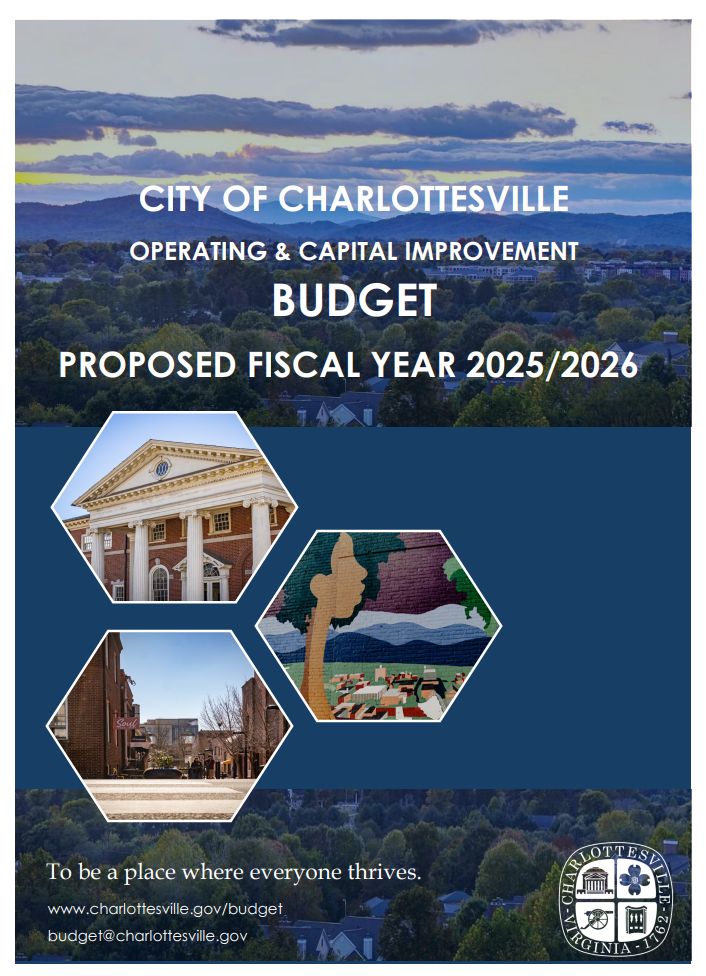
Here’s what the budget says on page 65.
“The FY26 projection for this revenue is roughly $117 million, which represents an increase of $8.6 million, or eight percent, over the adopted FY2025 budget,” reads the budget.
The increase is due to an overall reassessment increase of 7.74 percent for 2025, as reported in January.
When the next public notice in the Charlottesville Daily Progress is printed to advertise the 2025 tax rates, state code requires it to list these four items:
- “Total assessed value of real property, excluding additional assessments due to new construction of improvements to property, exceeds last year’s total assessed value of real property by 7.36 percent.”
- “The tax rate which would levy the same amount of real estate tax as last year, when multiplied by the new total assessed value of real estate with the exclusions mentioned above, would be $0.9128 per $100 of assessed value. This rate will be known as the ‘lowered tax rate.’”
- “The City of Charlottesville proposes to adopt a real estate tax rate of $0.98 per $100 of assessed value. The difference between the lowered tax rate and the proposed rate would be $0.0672 per $100 or 7.359 percent. This difference will be known as the “effective tax rate increase.”
- “Based on the proposed real property tax rate and changes in other revenues, the total budget of the City of Charlottesville will exceed last year’s by 4.97 percent.”
Virginia code does not require the above information to be posted in the budget document itself. Council was also not given these specifics on Monday night.
For another example of what other communities do, look at a release sent out this afternoon by the City of Lynchburg that follows the same format.

The first public hearing on the budget was held on March 20 as part of the Community Budget Forum. A second public hearing was held Monday as introduced by budget director Krisy Hammill.
“We’ve also talked about some amendments and changes along the way through our work sessions,” Hammill said. “We’ll have a work session this Thursday night to work on finalizing some of those.”
Sanders said Council will still move forward with the budget process and the hearing on the tax rate can take place after adoption.
“We’re still moving forward through the budget process and we are making sure that we adhere to our obligation to provide proper public notice for the public hearing related to the tax levy,” Sanders said. “So that is what we’re resetting. We’re resetting the order in which that happens.”
In Virginia, a separate public hearing must be held for the budget and the tax rates. The second public hearing proceeded and the only speaker was Jim Moore who said many in the city are becoming cost burdened by increasing tax bills.
“Your notice that you put in the ad specifically says there will be an effective tax rate increase of 7.359 percent,” Moore said.
He said one property he owns now has a real estate tax bill for 2025 that is $1,104 higher than in 2021.
“I encourage you to consider whether your tax trajectories are sustainable without unduly straining residents,” Moore said.
The second public hearing on the budget also served as the first of two readings to adopt the budget. The second reading will be on April 14. There will also need to be two readings of the tax rates.
Before you go: This story was originally posted in the April 9, 2025 edition of Charlottesville Community Engagement. To support this work, consider a paid subscription to the newsletter or support through Patreon. Checks are also welcome!
Discover more from Information Charlottesville
Subscribe to get the latest posts sent to your email.


