The Constitution of Virginia can only be amended after a proposal makes it through two consecutive sessions of the General Assembly with an election in between. That process can be seen unfolding this year when all 100 seats of the House of Delegates are on the ballot in November.
Three proposed amendments to Virginia’s constitution have already passed the House of Delegates in this session on the right to abortion, the right to marry, and the right to vote. (read previous story)
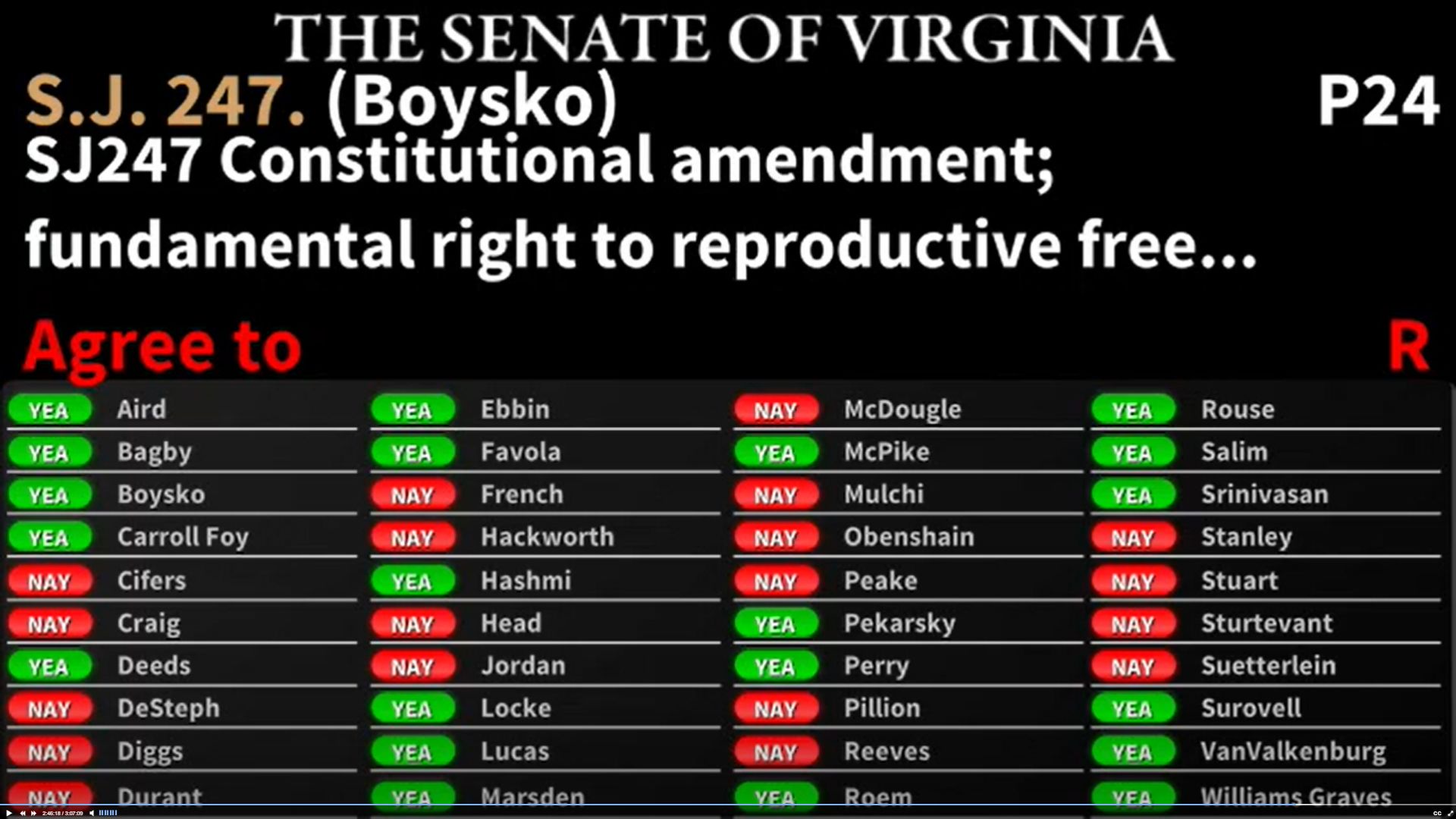
Their Senate companions were up for a final vote on January 21. The first was SJ247 as described by Senate Clerk Susan Clarke Schaar.
“Proposing an amendment to the Constitution of Virginia by adding Section #11-A relating to fundamental right to reproductive freedom,” read the clerk.
The bill’s chief patron is Senator Jennifer Boysko (D-38) who said the amendment is necessary in the wake of the Supreme Court decision that ended federal protection on abortion.
“Every one of us in this chamber, I believe, probably remembers June 24, 2022, when the Dobbs decision overturned and the Supreme Court ended what all of us have seen over the past 50 years as a federal constitutional right to abortion, handing our power to make decisions about ourselves and to control our own bodies back to the states,” Boysko said.

Boysko said the amendment would take the issue out of the General Assembly’s hands at a time when other legislatures are making it a crime for certain procedures to be conducted.
“I know for sure that every patient is different and every pregnancy is unique, even from person to person and their pregnancies,” Boysko said. “I had one of those very difficult ones and nearly died and had a doctor telling me that if we didn’t do something that my daughter sitting next to me would no longer have a mother.”
The resolution had to be read three times before adoption, and Republicans suggested several amendments which failed on January 20. The next day Senator Tara Durant (R-27) argued that if adopted, this Constitutional amendment would take away parental rights.
“We are saying we are no longer going to respect parental authority enshrined in the very fabric of us as a mother, as a father, and to say strangers will make that decision that could threaten your child’s life.” Durant said.
In response, Senator Scott Surovell (D-34) said that the U.S. Supreme Court case of Troxell v. Granville established that parents have the fundamental right to care, custody, and control of their children.
“That U.S. Supreme Court case trumps anything that we do in this body, in the code or otherwise,” Surovell said.
This exchange continued for a few minutes.
Senator Travis Hackworth (R-5) shared the personal story of his daughter-in-law whose unborn child died at 32 weeks in September 2020.
“They immediately did delivery,” Hackworth said. “That evening she was born and it’s very emotional, but I have a picture on my phone where that her hand is wrapped around my finger. 32 weeks old, beautiful, fully formed and I remember promising Allie Rose Hackworth that I would always stand up and fight for her, the millions of unborn babies just like her.”
The newest member of the Senate, Luther Cifers of the 10th District, said that Roe v. Wade had failed to take into consideration the rights of the unborn child.
“This is a legal argument, but it is certainly not a moral one,” Cifers said. “Particularly in light of the fact that an estimated 95 percent of abortions are not related to rape, incest or the health of the mother. They are in fact the taking of a life for the sake of convenience.”
Arguments continued about parental involvement. Senator Scott Surovell dismissed many of them but ran afoul of Lieutenant Governor Winsome Earle-Sears.
“Roe v. Wade lived in happy harmony with the parental consent laws until it was abolished by the U.S. supreme Court in Dobbs after Mitch McConnell stole a Supreme Court pick, another guy got on after a background check that never really got fully done,” Surovell said before Earle-Sears gaveled him out of order.
You can hear that entire interchange in the next podcast edition. Or here on SoundCloud.
Surovell called for an appeal and the Chamber went “at-ease” for 25 minutes before there was a mini-debate about whether the U.S. Senate denied President Barack Obama the right to replace the late Justice Antonin Scalia when he died in February 2016, a full eleven months before Obama left office. Obama had nominated Merick Garland as a replacement, but Mitch McConnell, the Senate Majority Leader, refused to schedule confirmation hearings.
A motion to sustain Earle-Sears’ ruling failed and debate on SJ247 continued. Senator Boysko had the opportunity to make a final comment before a vote was taken.
“The focus on parental consent is an attempt to withstand, distract from the real motives that people have here, which is to ban abortion,” Boysko said, adding she understood the pain Senator Hackworth must have felt.
“There are so many other nightmares that people have lived with who have not had adequate care, who have not had the ability to have a doctor save their lives and have died on gurneys, they have died in their homes,” Boysko said. “This is a powerful and emotion driven issue for everybody in this room.”
After debate had finally trickled out, a vote was taken and SJ247 moved forward with a party-line vote of 21 in favor and 19 against. The resolution follows passage in the House of Delegates on January 14 of HJ1. That bill awaits action in the Senate Privileges and Elections Committee.
The next item of business was a third reading of Senate Joint Resolution 248 which would establish the fundamental right to vote. Senator Mamie Locke (D-23) explained the reason for the legislation.
“During a period of incarceration for a felony conviction, a person cannot vote,” Locke said. “However, as stipulated by this amendment, upon release from incarceration for that felony conviction, and without any further action being required, that individual will be invested with all political rights, including the right to vote.”
Senator Ryan McDougle (R-26) said many felons may have learned their lessons, but others may not have done so. He said restoration of voting rights should continue to be done on an individual basis.
“I am confident that there are individuals that have committed some of those violent crimes that have atoned for their offences,” McDougle said. “But Madam President, I do not think it should be blanket.”
The vote was 21 to 18 with Senator Emily Jordan (R-19) not voting.
The third Constitutional amendment before the Senate was SJ249 which was introduced by Senator Adam Ebbin (D-39). He asked the Senate two questions.
“Do we want to bring our state’s Constitution into alignment with the laws of the United States?” Ebbin asked. “[That] would be the first question. And the second is, do we or do we not want to recognize the realities of the 21st century? One of those realities is that gay people can now get married.”
There was no discussion and the vote was 24 Senators in favor and 15 opposed. Senator Jordan also did not vote.

Before you go: This article was originally sent out as part of the Charlottesville Community Engagement newsletter in the January 22, 2025 edition. Both are functions of Town Crier Productions. You can support the work by purchasing a paid subscription or contributing monthly through Patreon. You can also send in a check or send an email, but drop me a line first.
Discover more from Information Charlottesville
Subscribe to get the latest posts sent to your email.