For nearly ten years, the Virginia Department of Transportation has used a ranking system called Smart Scale to review potential projects.
“Smart Scale is a data driven outcome based prioritization process,” said Brooke Jackson, the program’s manager. “It was put in place to improve the transparency and accountability of project selection and stabilizing the six year improvement program.”
The cycle runs every two years and a draft set of recommendations was announced on January 14 at the first meeting of the Commonwealth Transportation Board for 2025.
This year there is less funding available for the program than previous years in part because of an increasing need to pay for maintenance as well as costly repairs due to Hurricane Helene as well as this year’s winter storm.
“Finishing fiscal year 2025 is uncertain based on activity to date for VDOT,” said Laura Farmer, VDOT’s Chief Financial Officer. “And so we need to monitor our spending and any additional events between now and the March time frame, hopefully when spring comes, and understand the implications to the department.”
Transportation Secretary Shep Miller was a member of the CTB when the program first began after being mandated by legislation in the 2014 General Assembly.
“One thing that we’ve done substantially in terms of improvement is to really work to get quality applications in,” Miller said. “As you know, as we saw last year and before that, there were too many applications coming, some of which, too many of which were not ready.”
For instance, the City of Charlottesville had been very successful in obtaining funds in earlier rounds but has yet to begin construction on any of the projects. Several have now been canceled and Charlottesville did not apply for new funds in Round 5 or Round 6.

Jackson said there is a large cost-benefit analysis component to the work and leverage from localities, regional entities, and other sources can improve a project’s score. Each project is reviewed under six criteria that are weighted according to CTB policy. This time around, 45 percent of submitted projects were ones that had previously been reviewed. Another unofficial factor in Round 6 is a locality’s success rate at bringing projects to construction.
There were 325 pre-applications in Round 6 with a total of 277 applications, 270 of which were scored. That’s down from Round 5 when 490 pre-applications resulted in 413 applications.
“This round we have recommended 53 projects for funding and the total funding requested this round was $8.2 billion,” Jackson said.
Jackson noted that this year the total amount of leverage offered is about ten percent, a number Miller said was much lower than he would like.
The Culpeper District is currently slated to receive $68 million through the district grant program. There’s a second pool of funding available for high priority projects.
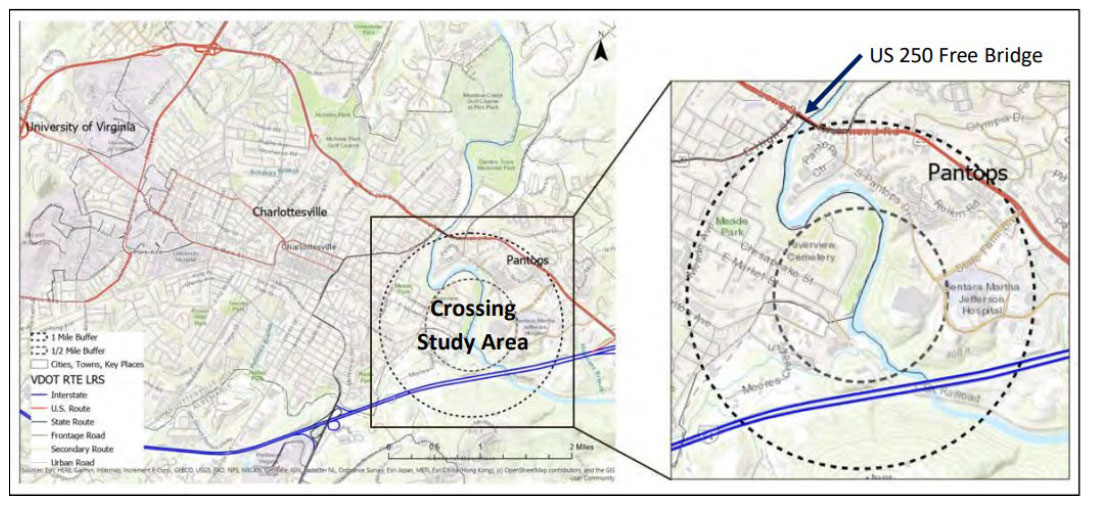
There were 24 applications from the Culpeper District and four have been recommended for funding. Only one of these is in the Charlottesville area and that is a $36.4 million project to make several improvements on U.S. 250 at Pantops, all funded though the high priority project pool. That came out of one of VDOT’s pipeline studies.
Projects that have not made the initial cut include improvements at Old Trail Drive and U.S. 250 in Crozet, a restricted crossing U-turn at U.S. 29 and Plank Road, and projects submitted to alter the Barracks Road corridor between U.S. 250 and Emmet Street. Other Albemarle-centric projects not funded are a double-roundabout at the intersection of Rio Road East, Northfield, and Old Brook and conversion of Interstate 64’s interchange at Fifth Street Extended into a diamond interchange.
Nelson County is within VDOT’s Lynchburg District and a project to create a roundabout at Route 151 and Tanbark Drive is slated to receive nearly $12.7 million. The county had submitted two other projects as well.
Louisa County, Fluvanna County, and Greene County are all within the Culpeper District. Fluvanna did not submit any projects, but here are the unsuccessful projects:
- Greene County — RT29-616 RCUT Project Highway
- Greene County — US33-743 (Advance Mills) & 1050 (Greenecroft) Intersections Highway
- Louisa County — Route 250 and Route 15 – Intersection Improvement Highway
- Louisa County — Route 208 & Route 250 – Intersection Improvement Highway
- Louisa County — Route 15-22 Intersection Improvements Highway
The scores will next go before the CTB in April for another review before a vote in June.

Before you go: This article was originally sent out as part of the Charlottesville Community Engagement newsletter in the January 14, 2025 edition. Both are functions of Town Crier Productions. You can support the work by purchasing a paid subscription or contributing monthly through Patreon. You can also send in a check or send an email, but drop me a line first.
Discover more from Information Charlottesville
Subscribe to get the latest posts sent to your email.