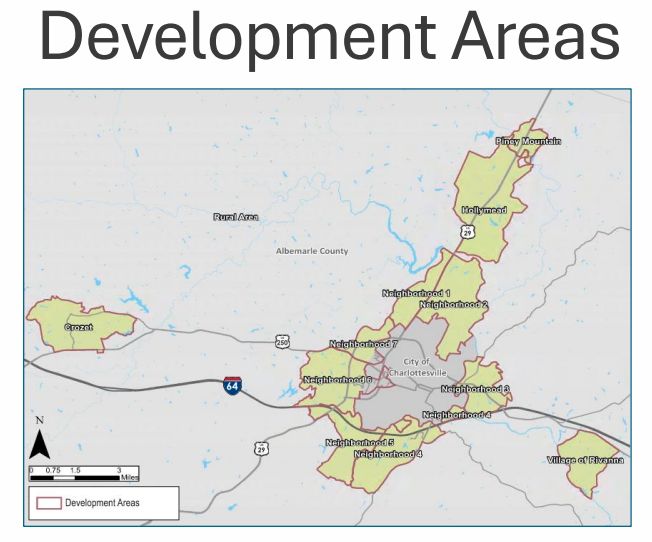
If Albemarle County is to keep its growth area boundaries intact without an expansion, staff has told the Planning Commission and the Board of Supervisors that they will need to keep a close eye on how the development area is being used.
In the early stages of the AC44 Comprehensive Plan update, staff and the firm Kimley Horn took a look at 20 residential rezonings that took place between 2016 and 2021.
“When analyzing the actual buildout of these rezoning developments, the total number of units approved was approximately 58 percent of the maximum number of units recommended per the Comprehensive Plan,” reads what’s called a build-out analysis. (read the document)
Members of both bodies have asked for more metrics and now a consultant will be hired to provide that analysis. Supervisors got an update at the very beginning of a November 6, 2024 work session on the Comprehensive Plan.
“I have been instructed by the County Executive’s office to reach out to a couple consulting firms with which we work to see about establishing a scope of work to help us with those formulas,” said Community Development Director Jodie Filardo.
The topic at this work session also related to development area utilization by introducing Supervisors to the future land use categories that will be used on the future land use map, as well an update of what county staff refer to as activity and employment centers. The Planning Commission had a look at the same material on October 22, 2024 if you want to go into more detail.

As a reminder, the AC44 process has been underway for three years now as Supervisors approved a resolution on November 3, 2021. There have been two phases of input so far according to Planning Manager Tonya Swarzendruber.
“Some of the input themes that we heard during phase one and two is that development should be walkable and mixed use with a variety of housing types, looking for those activity centers to pair higher density with amenities and recreation, and also encourage infill development,” Swarzendruber said.
Swarzendruber said people who participated encouraged investment in existing neighborhoods as well as linking transportation and land use. These basic themes have been part of the comprehensive planning process in Albemarle for a long time, but the difference this time around is that the lower end of the land use categories calls for three to six units per acre.

As one way to increase the number of housing units, staff are suggesting increasing development rights in all areas classified as “neighborhood residential.”
“One way to address housing choice is to allow detached accessory units in all residential zoning districts for single family detached houses so these types of units could be built throughout the development areas,” Swarzendruber said.
That would take a change to the zoning code, a change that would be informed by the Comprehensive Plan.
As for activity centers, staff is recommending reducing those from around 50 centers in the current plan down to about 30 to make it more likely for the planning ideals to be implemented.
For decades, the Comprehensive Plan has encouraged that new residences be built in the development area, which is on about five percent of the land. The current draft continues that principle.
Supervisor Ned Gallaway of the Rio District noted that many who attended a meeting of all of the county’s growth area advisory committees wanted better information on how the county has done so far.
“That is a good question,” Gallaway said. “I think the utilization review is going to get there but I think it goes beyond just the percentages. It has to be, well, how well have we done providing the transit and the transportation and all of that?”
Gallaway said several Supervisors had asked for scorecards for how each new proposed rezoning would meet the theoretical maximum so elected officials could know in real-time how they are meeting planning goals.
“I don’t see mention of that in here now it may not be figured out how you’re going to do that but that idea was endorsed and it’s my expectation that those would be put into draughts for the next time that we address it,” Gallaway said.

Gallaway said he was skeptical that many of the activity centers are realistic, especially ones that may be considered entertainment destinations in the future because the population isn’t enough to support more movie theaters. He also said that many of the places that had been promised as centers didn’t pan out when development actually happened.
“Belvedere was supposed to have a lot of retail and other components built into it based on that model,” Gallaway said, “There is a dentist office, there’s the Center, which wasn’t even thought of back then. That’s it.”
Back then was 2004 when Supervisors approved the development, which was to have included at least 25,000 square feet of commercial space.
In 2024, the developers of Brookhill are asking to scale back the amount of commercial space in the 88 acre development as I reported in the October 30, 2024 C-Ville Weekly.
Supervisor Bea LaPisto-Kirtley of the Rivanna District echoed Gallaway’s comments on centers, pointing out at one point an ice rink had been planned for Brookhill. She said people who own land need to get involved.
“Can they give us ideas?” LaPisto-Kirtley said. “I don’t know. Because let’s face it, if you have an area, if you have land and the developers don’t want to do anything there or build what you want them to build, that’s not going to happen.”
It should be noted as well that the Great Eastern Management Company has sought a rezoning of the approved North Pointe development to allow more homes and less commercial. GEMC also owns the Riverbend Shopping Center which is listed as a center.
On the topic of accessory dwelling units, Gallaway said he would support having those need to be approved by the Board of Supervisors. Supervisor Ann Mallek of the White Hall District said she was skeptical that allowing them everywhere would increase the number of affordable units.
“The cost for a homeowner to do this is absolutely unsupportable by anything except a tenant who is a university student who’s going to pay you several thousand dollars a month for living there,” Mallek said.
Mallek also said older neighborhoods in Crozet could not support additional units but she would reserve complete judgment until there are more details.
Supervisor Diantha McKeel said she would support accessory units with many caveats.
“I get very concerned in a University town if you start just putting a lot of accessory dwelling units,” McKeel said. “What you’re going to do is to take the load off of the University of Virginia and you’re going to end up providing housing in many areas for UVA students.”
McKeel said UVA needs to be part of the conversation about housing students. Here are some examples of what UVA is doing:
- The University of Virginia is currently planning to build up to 2,000 beds as part of an initiative to house second-year students on Grounds.
- There is a master plan for the Ivy Garden apartment complex that UVA owns between North Grounds and Central Grounds that anticipates increasing the number of apartments from 440 to 718. I wrote about that, too.
- The Darden School of Business just broke ground on student housing. Here’s an article I did not write.
- The University of Virginia will build an unknown number of units at the North Fork Discovery Park. I need to do an update on that.
McKeel also said she didn’t mind if more people live in the rural area.
“Some people want to live in Fluvanna,” McKeel said. “We should not just broad stroke that everybody has to live in [the development area]. Having said that we should be providing transit and some way for them to get to work and back if they want it.”

Another item that came up at the Planning Commission’s October 16 meeting was the idea of adding additional development areas to replace land that has not been developed with density such as the Village of Rivanna. McKeel supported the idea.
“ Let’s see if we can do some trading possibly of development area [land] where something can actually happen,” McKeel said.
Supervisor Michael Pruitt of the Scottsville District called the Village of Rivanna a failure of planning that should be corrected.
“I know the residents of the Village of Rivanna that I speak to are not happy with the fact that they continue to be a development area,” Pruitt said. “They don’t like the looming sword of Damocles of potentially the small remaining undeveloped lots being built out.”
Pruitt wanted to know what it would look to find additional land that could be traded out, though he acknowledged the Albemarle County Service Authority has already build infrastructure to support higher density that will never materialize.
Pruitt also said Albemarle owes its citizens more frequent updates of the Comprehensive Plan. The last one was adopted in the summer of 2015. He also questioned whether enough people are participating, pointing out that relying on the community advisory committees may not be enough.
Pruitt indirectly referred to Charlottesville’s Cville Plans Together initiative which resulted in an affordable housing plan, a Comprehensive Plan, and a new zoning code.
“There’s a lot of things that I don’t think Charlottesville’s government does the way I would like it done, but they did have, I think, a very robust and challenging but productive conversation on their [Future Land Use Map],” Pruitt said. “I’m not sure if I have ever had a constituent ask, when do I give feedback on our Future Land Use Map? I don’t know what I’m actually supposed to tell them and I don’t know when I’m supposed to be getting feedback on the Future Land Use Map.”
Pruitt said he felt there might still be too many centers on the map given the amount of time it takes to get infrastructure built. He said he lives within a half mile of the South Side Shopping Center which has a grocery store and a restaurant, but walking there is impossible.
“I have to walk uphill against traffic in a single lane road for part of it in order to get to Tangerine’s Kitchen, which is a place I like and would go to dinner walking if I could safely,” Pruitt said. “But I can’t, even though it’s five minutes walking up the street.”
Supervisor Jim Andrews of the Samuel Miller District said he supported having a conversation about the Village of Rivanna, but that was not appropriate at this point of the Comprehensive Plan. He also said he would support accessory units being by-right where they are appropriate, suggesting activity centers might be such a location.
“I was fascinated by and trying to understand further the idea of accessory dwelling units being done by developers,” Andrews said. “I guess I do recall that in Southwood there are some units that are kind of townhouses but behind them there are accessory units.”
More on the Comprehensive Plan in future editions of Charlottesville Community Engagement.
Before you go: The time to write and research of this article is covered by paid subscribers to Charlottesville Community Engagement. In fact, this particular installment is from the November 19, 2024 edition of the newsletter. To ensure this research can be sustained, please consider becoming a paid subscriber or contributing monthly through Patreon.
Discover more from Information Charlottesville
Subscribe to get the latest posts sent to your email.