A democratic system of government allows people to make comments about intricate details on public policy. That was the case at the October 23 meeting of the Charlottesville-Albemarle Metropolitan Planning Organization Policy Board when the body was expected to take a final vote on changes to how the Federal Highway Administration classifies some city streets.
Every ten years after a Census, the FHA updates the “functional classification” of roadways that describes how they are being used. These range from “local road” to “interstate highway.”
For background, here’s a story I wrote earlier this month that is posted to Information Charlottesville.
Each MPO Policy Board meeting begins with a public comment period.
On October 23, East Market Street resident and former Charlottesville Planning Commissioner Bill Emory said members of the Woolen Mills neighborhood have been asking for traffic calming measures since 1988. He presented a petition asking that the city not recommend a classification change for his street from “local road” to “minor collector.”

“If they are now federally functionally classified as collector roads, that designation will weigh against the neighborhood’s use of the Commons for the next 100 years,” Emory said. “There’s a stark difference between applying labels and thoughtful planning.”
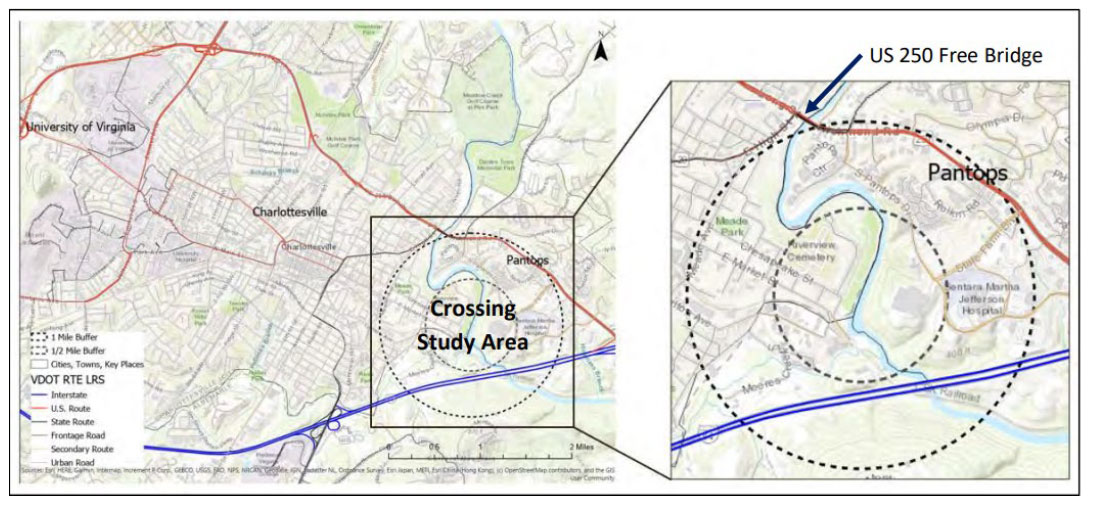
Mobility activist Kevin Cox was concerned that changing the designation would eventually lead to planning to build a second vehicular bridge.
“Transportation planners, who are sort of separated from the community or whatever, look at a map and you see downtown and you see this straight line that goes right to the interstate at Shadwell,, and that straight line goes down Market street and across the Rivanna river, that is going to be perennial problem,” Cox said. “It’s a natural route and people are going to see it, say, that’s where we need a second bridge to divert the flow from Free Bridge. So this is going to come up. I don’t trust this because I really do fear that this is the beginning setting the stage for that future.”
There are no plans for such a bridge but the MPO Policy Board has endorsed a proposal to build a pedestrian bridge across the Rivanna at the end of Market Street near the Wool Factory. That project remains in limbo after an increase in the cost estimate and a failure to qualify for Smart Scale funding.
Christine Jacobs, the executive director of the Thomas Jefferson Planning District Commission, said that the review of functional classifications began this spring. The TJPDC also operates the MPO.
“In early May, MPO staff sent a request to all locality staff for their detailed review and included in that email the draft GIS map, the comprehensive [functional classification] guide with all of the criteria and procedures to review and the methodology that was used for the review,” Jacobs said.
The three MPO committees were presented with the information in May as well as an initial assessment of changes made by staff at the Virginia Department of Transportation. Recommendations from local staff went through the MPO committees in August, but a vote was deferred because there was no map depicting all of the changes. That was ready by the October 23 meeting and Jacobs said the MPO’s vote was key to illustrate local approval of the federally-mandated process.
“So before the Policy Board tonight is a final revised version of that map along with a resolution that asks you to consider approval of the proposed changes, as well as documenting within that resolution, documenting to [Federal Highway Administration] that the MPO was participating within VDOT’s review, that it wasn’t done completely by VDOT staff, that it involved the CAMPO and locality staff in that review and then the state, upon your consideration, if that were approved, the state would then send the resolution and the finalized map up to Federal Highways for their review,” Jacobs said.
Ben Chambers, the city’s transportation planning manager, said Charlottesville’s review sought to see if roads were still appropriate given any changes in conditions that might have occurred. For instance, a portion of 9th Street SW in Fifeville from Estes to King Street is still listed as a minor collector despite being a cul-de-sac. That’s a leftover from before construction of the Roosevelt Brown Boulevard.
“Then we went into lower density neighborhoods like Woolen Mills, Johnson Village,” Chambers said. “We looked at some of the streets and [asked] how are these streets functioning? Because we know that there is traffic flowing through these neighborhoods.”
Chambers said staff looked at traffic volumes, the current physical conditions of the streets, and destinations. They also look at whether there was transit service and whether there were sidewalks.
This resulted in several recommended changes:
- Hillsdale Drive from local road to major collector
- Cherry Avenue from Ridge Street to Roosevelt Brown from major collector to minor arterial
- Chesapeake and East Market Street in the Woolen Mills from local road to minor collector
- Franklin Street from Meade to Carlton Avenue from local road to minor collector
- Prospect Avenue from 9th Street SW to Bailey Road from local road to minor collector
- Bailey Road from Fifth Street SW from local road to minor collector
- Rose Hill Drive from Oakleaf Lane to Rugby Avenue from local road to major/minor collector
Chambers said one goal is to be able to get federal funding for improvements to some of these roads. He said the work is intended to describe what the roads are doing now as opposed to planning for future growth.
In Albemarle County, many of the changes from major collector to minor arterial are intended to ensure the roadways are eligible to serve as entrance corridors.
Supervisor Ann Mallek, an MPO Policy Board member, asked if any of the changes would make it harder to slow down traffic as they pass through neighborhoods. Chuck Proctor, a VDOT engineer, explained some of the parameters.
“In the guidelines for functional classification, as long as you’re below an arterial, you can do a lot of things from a traffic calming perspective,” Proctor said. “They’re not prohibited. Once you become an arterial, that’s when a lot more stricter regulations come. Basically, those roads are for a lot more through traffic and to carry your commercial and your larger vehicles through your network.”
Proctor said in the case of Market Street and Chesapeake, they were suggested to be upgraded to minor collector because Charlottesville Area Transit operates the Route 1 service on them. Additionally, Riverview Park is a destination. Proctor said Charlottesville makes its own decisions on roads rather than VDOT.

Chambers said the changes are meant to draw down more money to make the city more walkable and bikeable. There are many different types of grant applications and these changes might help them stand out.
“Updating functional classification just gets us opportunities to get funding for paving, it gets us opportunities to get funding for roads, for things like SmartScale and for things like [Transportation Alternatives Program] funding, where you might want to be able to point out that, hey, this is an important street in our neighborhood that we need to focus on,” Chambers said.
Chambers had the support of City Councilor Natalie Oschrin, who said she had been concerned about the city changes when it was last before the MPO.
“I’ve been talked into understanding it better,” Oschrin said. “I empathize with all of the commentary that we’ve been getting from people who haven’t gotten these full presentations and are nervous that this sounds like, okay, we’re gonna now we’re available to widen your road and then you’re gonna put up, you know, big highway construction in your city. Because that has happened before. There is evidence of that. So I get that sense of unease. But this isn’t that.”
City Councilor Brian Pinkston told the MPO Policy Board that two days before their October meeting, City Manager Sam Sanders announced he had tasked staff to look at the possibility of lowering the speed limit to 25 miles per hour across the city.
The MPO Policy voted unanimously to recommend the changes which will now go to the Federal Highway Administration for approval.
Before you go: The time to write and research of this article is covered by paid subscribers to Charlottesville Community Engagement. In fact, this particular installment is from the October 29, 2024 edition of the newsletter. To ensure this research can be sustained, please consider becoming a paid subscriber or contributing monthly through Patreon.
Discover more from Information Charlottesville
Subscribe to get the latest posts sent to your email.