July 4, 2025 was the 249th anniversary of the Declaration of Independence. In the morning, Monticello once again played the role of being a federal court for the purposes of swearing in 74 new citizens of the United States of America. Introduced by the Lewis and Clark Fife and Drum Corps, the annual event is an opportunity to celebrate citizenship and of course this well-known document penned by Thomas Jefferson.
This is the 63rd time that Monticello has served as the backdrop for a naturalization ceremony on July 4.
“The fundamental principles embedded in the Declaration, liberty, equality and self government, are still the basis for our nation’s promise and its aspirations,” said Molly Hardie, chair of the Board of Trustees of the Thomas Jefferson Foundation. “Throughout our history, they have provided a rallying cry for freedom movements within our country and around the world.”
Dr. Jane Kamensky is the president of Monticello began her remarks by noting the many community partners including one that is currently without its own leader following a demand from the federal government that Jim Ryan step down.
“The great and good university hatched from Thomas Jefferson’s commitment to the public education of a virtuous citizenry,” Kamensky said. “Our partnership with UVA goes back to 1817, or even, by some reckoning, to 1779, the year of Virginia’s Bill for the Greater Diffusion of Knowledge.”
Kamensky said that the naturalization ceremony exemplifies what she described as the exceptionalism of the United States.
“There are many distinctive things about the American experiment, which turns 249 years old today,” Kamensky said. “The fact that the nation has a knowable moment of origin for one thing. But the exceptional thing I’m thinking about this morning is that almost everyone in the United States at the time of its founding had come there from someplace else in the not too distant past.”
Kamensky said that included people of African descent who were brought here against their will.
“Those African migrants accounted for nearly half of the 585,200 people arriving in North America between 1700 and 1776,” Kamensky said. “The enslaved people at Monticello were mostly born in Virginia, but their parents and grandparents came from West Central Africa and the Gold coast and the Bight of Biafra. And those languages and cultures were living memory here, just as the Saxon heritage of the English colonists was.”
Kamensky said Jefferson believed in immigration and felt the new country would serve as a beacon for people who wanted a better life or had to leave.
“The ability to leave one’s country and join another, Jefferson wrote in 1817, was a, ‘natural right, like our right of life, liberty and the pursuit of happiness,’” Kamensky said. “He thought it was not only right but strategic for the United States to be, quote, a sanctuary for those whom the misrule of Europe may compel to seek happiness in other climes.”
The speaker for the July 4 ceremony was filmmaker and documentarian Ken Burns who called Jefferson a person of contradictions and an enigma worth studying to this day.
“He was a lifelong champion of small government who took it upon himself to more than double the size of his country,” Burns said. “He distilled a century of enlightenment thinking into one remarkable sentence. The purest expression of freedom and liberty the world knows. Yet he owned more than 600 human beings and only freed perhaps 10 of them.”
Burns and his colleagues are working on a documentary on the American Revolution which will be released in November. He asked the crowd to think about the historic importance of the colonists decision to break free from Great Britain.
“In 1776, kings still ruled in France and Britain, a tsarina in St. Petersburg, a sultan in Constantinople, a divinely invested emperor in Beijing, and a shogun in Japan,” Burns said. “But in Philadelphia, a group of men met there to see whether they might be able to govern themselves.”
However, Burns said the six-part series will tell much more than the stories of people referred to as the founding fathers as there are many stories worth telling today. But he focused on Jefferson’s role in a country that has become divided nearly a quarter of a millennia later.
“How do we mediate the self division, as Robert Pen Warren would say in Thomas Jefferson and ourselves,” Burns said. “We want so to decide to nail him down. Is he good? Is he bad? Is he a Democrat? Is he a Republican? Is he mine? Is he yours? He is both. And we are both. And he and we are in this together. The greatest service we can render to Jefferson and our country is to accept his self divisions as a great mirror of our own possibilities and failings and to go forward.”
The ceremony did move forward.
“As Chief Judge of the United States District Court for the Western District of Virginia, it is my distinct honor and privilege on behalf of all of the judges of our court, to welcome our applicants to citizenship, our distinguished hosts and guests, and all who join us today to celebrate Independence Day with a naturalization ceremony at beautiful Monticello,” said Judge Elizabeth K. Dillon.
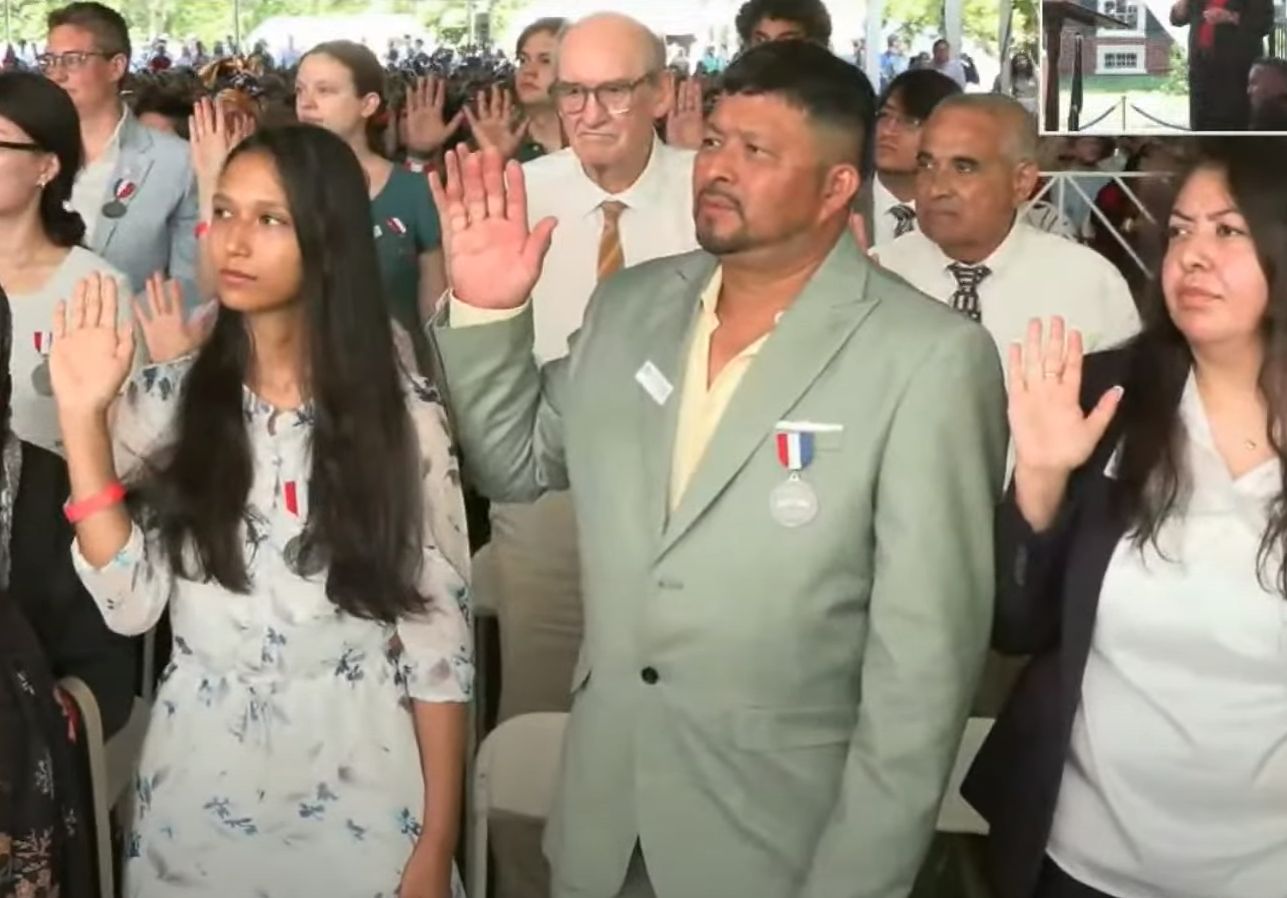
The 74 new citizens raised their arms to swear an oath to the country, then recited the Pledge of Allegiance, before everyone sang the Star Spangled Banner. The new group comes from all corners of the world and all were invited to speak at the end including one woman who arrived here in 2020.
“Leaving my home country was not easy but it was necessary for my safety, freedom and my girl’s future,” said the first speaker. “I’m deeply grateful for the rights and freedom that are [given] to us here right that many people around the world are still fighting to have.”
Another person emigrated from Ireland in the 1990’s and met his wife in 1999. He said he wanted to become a citizen to give back to his new country.
“I want to take part in the responsibilities of this country, not just the opportunities,” said Derek Naughton. “And I want my voice to count as a neighbor, a parent, and now finally, as an American.”
If you have a moment, take a look at the video of the entire ceremony or just skip to the end to hear all of the powerful stories.
Before you go: This story was originally in the audio version of Charlottesville Community Engagement the newsletter that aired July 5, 2025 on WTJU followed by a podcast later in the day. Then it was in the July 7, 2025 edition.
Discover more from Information Charlottesville
Subscribe to get the latest posts sent to your email.