The Year at UVA
To understand the future of the Albemarle-Charlottesville region, you have to anticipate where the University of Virginia is headed. That might be hard to track as there are multiple directions.
Money appears to be no object. Or at least, the Board of Visitors learned in late February that UVA surpassed their $5 billion capital campaign. In June, the UVA Buildings and Grounds
Committee approved a $2.06 billion capital campaign for 2024.
“We started last year in June with a $2.7 billion capital program,” said Colette Sheehy, the Senior Vice President for Operations and State Government Relations at UVA and oversees creation of the plan each year. “Over the course of the last 12 months we’ve finished $577 million worth of projects.”
In September, the Board of Visitors learned that UVA has received over $500 million in contributions for seven years in a row.
As for the future growth, let’s first go south into Fifeville where the relatively new tower of the UVA Hospital looms large.
The University of Virginia Health System purchased the Oak Lawn estate in Fifeville in the fall of 2023 for $3.5 million. In February, UVA put out a request for firms to begin planning for the future with a large focus on engagement with the Fifeville neighborhood.
In April, UVA issued a request for qualifications for an “owner’s representative” to help build whatever the state institution decides to build at properties just to the north on Grove Street.
“Since these sites are on the southern edge of Grounds, an important aspect of this planning study will be neighborhood engagement with the Fifeville community early in the process of developing the study,” the request continues. “Another important aspect will be the consideration of program options for the site(s) and are likely to include neighborhood clinics and procedure areas, community uses, and parking in a mixed-use format, although other options will be considered.”
UVA Health has a website with answers to frequently asked questions. The design consultants teams began work on feasibility studied in September and the community engagement will run through into this year.
“UVA Health is committed to exploring a mix of programs that allow us to provide services, like childcare and community health and wellness services, that meet the community’s needs,” reads the website.
There will be a work shop on the Grove Street concept on January 21 but the time and location has not yet been determined.

Taking action on building student housing
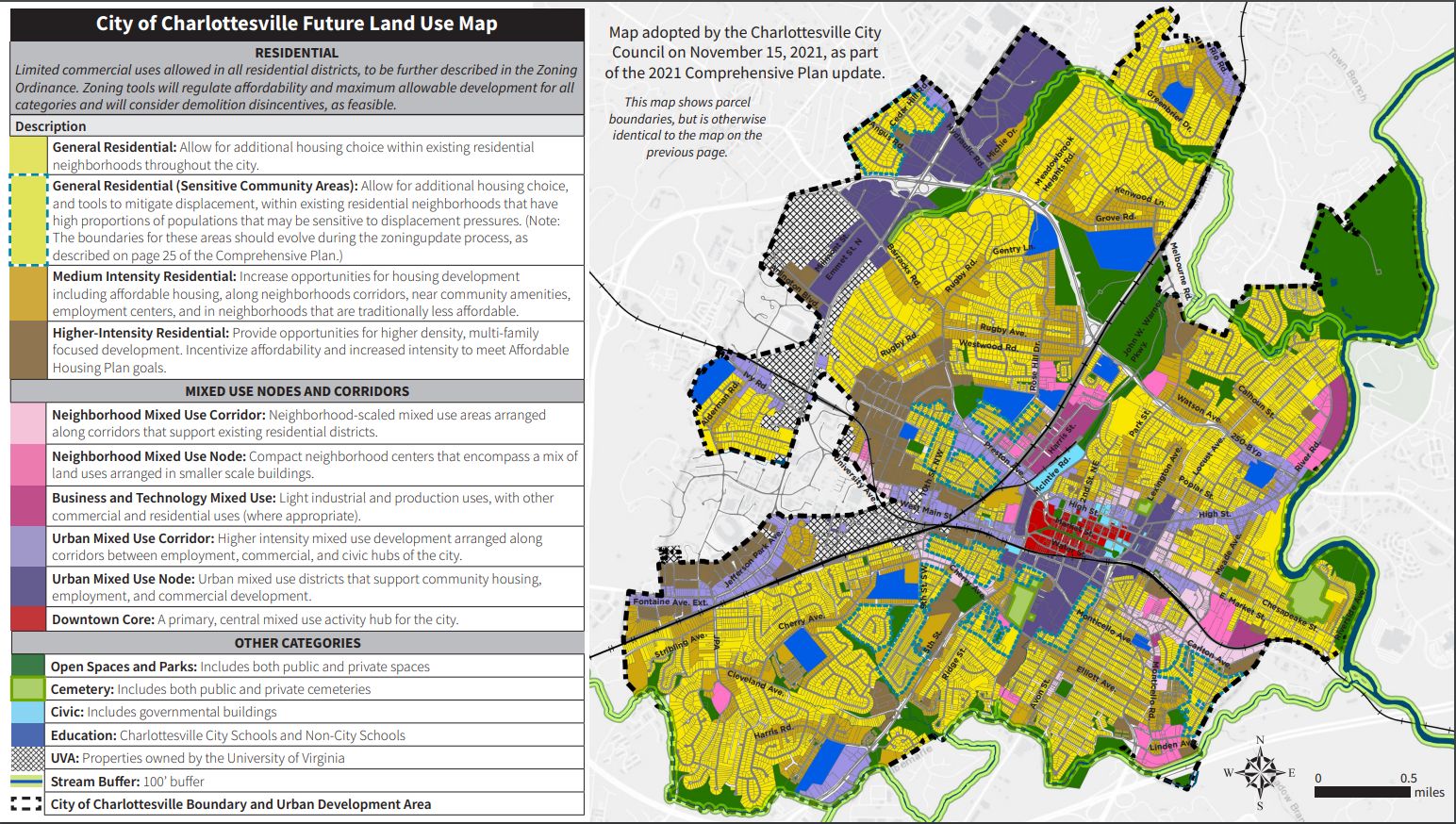
UVA is also expanding in an area between Central Grounds and North Grounds known as the Emmet / Ivy Corridor.
Ground was broken in October for student housing at the Darden School of Business as the school seeks to provide an amenity for students in a competitive environment. In all there will be 218 units of one, two, and studio apartments. The Board of Visitors endorsed that design in March as well as the location of a new parking garage to serve North Grounds.
In late April, UVA issued a request for qualifications for firms who would be interested in building up to 2,000 beds at new residential halls.
One of the sites is at the intersection of Emmet Street and Massie Road and the other is at the intersection of Emmett and Ivy Road. Both are identified in UVA’s master plan as suitable places for residential life.
The Emmet North project will be on a 16-acre site adjacent to Lambeth Apartments on the eastern side of U.S. 29. The RFQ describes the site as being ready for development once the Afghan Kabob restaurant is demolished. UVA has already demolished the University Apartments that used to stand just to the north.

The strategic plan for the University of Virginia calls for capital investments to make sure there is enough room to make it mandatory for all second-year students to live on campus.
“In order to house both first and second year students, plus retain accommodations for third and fourth years who want to live on Grounds, we need to build probably between 2000 and 2400 new beds,” said Colette Sheehy, senior vice president for operations and state government relations in September.
In December the Buildings and Grounds Committee reviewed the preliminary design for three residential buildings to be constructed along Copeley Road at the western end of the Emmet-Ivy Corridor.
UVA has hired Capstone Development Partners to lead construction of units that will be built on the western end of the Emmet-Ivy Corridor.
“The current design contemplates a three-building facility with 750-800 beds in apartment-style housing, as well as dining, programmatic, and retail spaces,” the report continues.
The residential halls were added to the UVA Major Capital Plan but one member of the Buildings and Grounds objected.
When it came time to make a motion to approve the schematic design, BOV member Bert Ellis said he would be voting against this design and all other construction projects.
“I’m going to vote no on any expenditures to be brought to this board until I have seen a 25/26 budget for this university that includes significant cuts in administrative expense,” said Bert Ellis. “I am on record and personally believe that we can take $200 million out of our budget and in the process, we can eliminate a lot of duplicative and counterproductive programs and services that have crept into our organization through, I think, lack of budgetary discipline by this board.”

Construction work also got underway on the Karsh Institute of Democracy. The Board of Visitors approved the design for the institute in June 2023 and construction is expected to be complete by 2026.
The UVA Foundation made several purchases this year including three properties on Arlington Boulevard for $10.5 million. The real estate group already owns 1982 Arlington Boulevard and 2102-2016 Arlington Boulevard.
All of the properties are zoned Node Mixed Use 10 under the city’s new Development Code but UVA is exempt. None of these properties are shown in the University of Virginia’s master plan known as the Grounds Plan: A Framework for Campus Planning. (view the document)
Other UVA-related items:
- In April, UVA issued a request for proposals for a firm to manage all of the various child care facilities that serve the needs of employees. The procurement website states that the bid closed in late June but has not been awarded. (read the story)
- In August, the UVA Foundation purchased an acre of land at 1761 Airport Road for $850,000. The property secures a gateway to the North Fork Discovery Park and Lewis and Clark Drive. (learn more)
Before you go: This article was originally posted to the Charlottesville Community Engagement newsletter on January 2, 2025. It’s the fourth in a series of articles about what happened in the 12 months that were 2024. The cost is covered by paid subscribers and other contributions, including advertisers and sponsors. If you’re interested in helping support the work, drop me a line!
Discover more from Information Charlottesville
Subscribe to get the latest posts sent to your email.