Since 1980, Albemarle County’s growth management strategy has been to locate residential and commercial density around the city of Charlottesville to avoid development of the rural area.
Albemarle’s last Comprehensive Plan was adopted in June 2015 and Strategy 8E of the transportation chapter calls for the county to “participate in the formation of a Regional Transit Authority (RTA) that is sufficiently funded to significantly expand transit service in the region with fast, frequent transit service along priority transit corridors.”

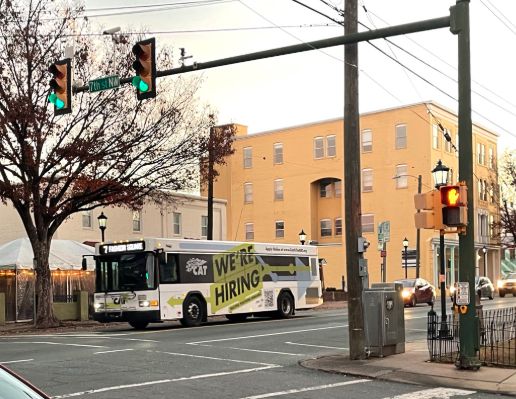
Nearly nine years later, a lot of planning work has gone into the idea with one deliverable being the formation of a Regional Transit Partnership consisting of Albemarle, Charlottesville, the University of Virginia. The city and UVA each own separate bus systems with very little overlap. Albemarle contracts with Charlottesville to fund the Charlottesville Area Transit service.
The idea of an authority was floated once before in the late 2000’s and legislation to create one passed the General Assembly. However, legislation to authorize a sales tax increase failed to get out of committee and the idea was shelved.
In the mid 2020’s, the situation in Charlottesville looks much the same as it did in the late 2000’s with three different transit systems with three different fleets. Ridership on CAT during that time has plummeted from 2.4 million in “unlinked trips” in 2013 to 1.15 million in 2022.
With some funding from the Virginia Department of Rail and Public Transportation, the Thomas Jefferson Planning District Commission has led two studies. A $350,000 Regional Transit Vision Plan offered two frameworks for more frequent running transit with the annual cost estimate of $35.5 million for service that would extend across all six localities. (view the final report dated November 30, 2022)
Then the Regional Transit Governance Study reviewed potential ways of how a new regional transit authority might bring in additional funding to help cover the cost of service. The firm AECOM worked on both studies. (view the draft final governance report dated February 2024)
“How could we find additional funds for the increased service that we want to be provided by this authority?” said Stephanie Amoaning-Yankson with AECOM.
The Regional Transit Partnership got a look at the final recommendations at their meeting on February 22. After over a year of work, the number one finding of the governance study is to pick right up from March 2010 when Albemarle and Charlottesville opted to shelve the authority.
“At the end of the study, what we recommended was activating… an existing legislation for the region that allows for setting up a transit authority,” Amoaning-Yankson said. “It’s available by legislation but it does not have any funding associated with it.”
Amoaning-Yankson said this would be an interim step to allow further discussion and that Albemarle and Charlottesville should join immediately. The other TJPDC localities are named in the 2009 legislation so their participation would not be a legislative obstacle. (take a look at HB2158)
Another next step would be to create a working group to draft by-laws and to shore up the organization before seeking legislation to bring in more revenue. The study recommends further conversations with UVA about their eventual participation.
“In other regions in the country that have major universities, we notice that the university systems were often crucial partners to the region and many times provided financial resources for transit in the region,” Amoaning-Yankson said.
Another recommendation is further study of what transit services are really needed in the rural areas.
“At several of our stakeholder meetings with the rural localities, we realized that the localities wanted to better understand what kind of transit they needed at a detailed level,” Amoaning-Yankson said. “They wanted to understand the proportions of their population that need transit service so they can make better decisions on how much they want to invest into transit as well.”
The Regional Transit Vision Plan did not go into that level of detail. Jaunt has contracted with North Dakota State University on a survey that is currently underway. (view the survey)

If the different localities decide to proceed with the formation of the authority, the Regional Transit Partnership would disband. Details would depend on what the working group comes up with. Albemarle Supervisor Diantha McKeel is the chair of the partnership and she said the whole idea is to fix a broken system.
“We all recognize that transit in this community is not working for everybody and we certainly have had struggles,” McKeel said. “We also recognize that in order to build a robust transit system, we have to have money.”
McKeel requested that staff begin the discussions of a work group to come back with recommendations within 90 days of February 22. That would be after both Albemarle and Charlottesville adopt budgets. Staff suggested it may take 120 days to draw up that work.
Christine Jacobs, the executive director of the Thomas Jefferson Planning District Commission, confirmed that one meeting of TJPDC, Charlottesville and Albemarle staff has occurred to develop those by-laws and next steps for moving forward.
Before you go: The time to write and research of this article is covered by paid subscribers to Charlottesville Community Engagement. In fact, this particular installment comes from the March 14, 2024 edition of the newsletter and podcast. The audio version of this segment is also in the radio edition that aired on WTJU on March 16, 2024 and archived on the Charlottesville Podcasting Network.
To ensure Town Crier Productions can continue to grow and continue to experiment, please consider becoming a paid subscriber or contributing monthly through Patreon.