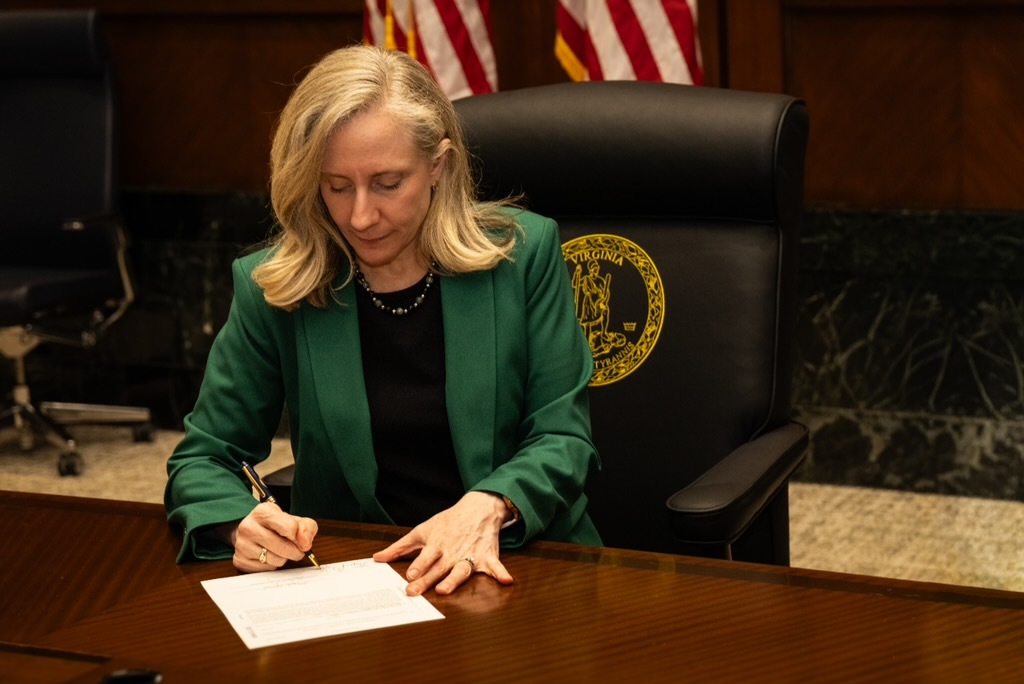
The 2024 General Assembly adjourned on Friday and Governor Glenn Youngkin has begun weighing in from the executive branch. On March 8, Youngkin took action on 84 bills, signing 64 into law, amending 12 bills and vetoing eight of them. In a statement, the Governor said most of the bills passed with bipartisan support.
“These bills cover a wide range of topic areas but demonstrate my continuing commitment to lowering the cost of living for Virginians, streamlining regulations, supporting our veterans, ensuring safe communities, and improving government efficiency,” Youngkin said.
Legislation that will become law include a prohibition on legacy admissions at higher educational institutions (HB48), allowing the City of Staunton to reduce or waive utility connection fees (HB136), and enshrining marriage quality in law (HB174). The European Honeybee will be the official state pollinator (HB517).

Legislation vetoed includes:
- HB46 would prevent the transfer of firearms to a person prohibited from owning one because of a protective order. This passed the House of Delegates 51 to 44 and the Senate 20 to 18. (view the veto explanation)
- SB47 was identical and also vetoed.
- HB833 would have provided that a person could not be found to be abusing or neglecting a child solely on the basis of having consumed substances that are now legal. This passed the House 56 to 43 and the Senate unanimously. (read the veto explanation)
- SB143 would have required at least two individuals to be on crew for a locomotive, train, or light engine moving freight. This passed the House of Delegates 51 to 48 and the Senate 21 to 19. Youngkin argued that federal regulations are the appropriate venue and that there is no evidence this would make railroads safer. (view the veto explanation)
- SB235 would have made clear that nothing in the mandated Department of Education rules to develop model policies on sexually explicit material could be used to ban books from school libraries. This passed the House of Delegates 53 to 46 and the Senate 22 to 18. Youngkin called the legislation unnecessary. (view the veto explanation)
- SB606 would have required Virginia to participate in the Electronic Registration Information Center. This passed the House of Delegates 51 to 49 and the Senate 21 to 19. Youngkin’s explanation went over the reasons his administration pulled out of the system. (view the veto explanation)
In Virginia, the Governor can make recommendations. Here’s a list of bills signed but with suggested changes that legislators can either approve or override.
- HB498 would require each School Board to develop a policy to notify parents of their responsibility to safely store firearms. This passed the House 54 to 45 and the Senate 22 to 17. Youngkin recommends that the bill won’t become law until it passes the 2025 General Assembly and added a requirement that School Boards also notify parents of their parental rights and parental responsibilities. (view the recommendations)
- HB597 would give localities the power to seek action or injunctions against landlords if units are considered to be in non-compliance with the rental agreement. This passed the House of Delegates 53 to 45 and the Senate 39 to 0. Youngkin also recommends this has to pass again in 2025 and also would direct the Department of Housing and Community Development to develop a report listing all amendments to the Virginia Residential Landlord and Tenant Act over the past five years. (view the recommendations)
- SB189 to allow Virginia Beach to transition to an elected Mayor with ten Councilors passed the Senate unanimously and the House of Delegates 68 to 31 with one abstention. Youngkin also recommends requiring this not become law until it passes again in 2025. The Governor’s office explains this is to let a lawsuit to stop the move play out. Voters in Virginia Beach approved the move in 2022.
- SB196 would prohibit the use of voter lists from other states for auditing purposes and would stop the practice of allowing registrars to review challenges to voter registrations with that instead being assigned to the court system. That passed the Senate 32 to 8 and the House 52 to 46. Youngkin made what appear to be technical recommendations. (view the recommendations)
Before you go: The time to write and research of this article is covered by paid subscribers to Charlottesville Community Engagement. In fact, this particular installment comes from the March 11, 2024 edition of the newsletter and podcast. To ensure this research can be sustained, please consider becoming a paid subscriber or contributing monthly through Patreon.
Discover more from Information Charlottesville
Subscribe to get the latest posts sent to your email.