

We’re in the time of year when localities across Virginia are well along the way of putting together budgets for the next fiscal year which begins on July 1. For localities that assess their property each year, a major driver in the budget development process is the release of new data on the fair market value for every parcel of land.
On January 17, Albemarle Supervisors were briefed on new property values for 2024. The overall average increased by a single-digit figure after double-digit increases in 2022 and 2023.
“This year what we’re looking at is a 4.07 percent overall increase to the tax base based on the reassessment,” said Peter Lynch, Albemarle County’s assessor.
That’s based on 1,856 validated sales in 2023 which is also the lowest number in the past seven years.
County Executive Jeffrey Richardson noted that this will provide less revenue growth to Albemarle for the next budget cycle.
“That’s after two years of 8.4 percent and 13.46 percent, which is an average of 10.93,” Richardson said. “So we’ve seen assessments go down approaching about seven percent.”
Richardson said this will be part of a challenging budget process.

A total of 386 new parcels were created bringing the total to 49,498.
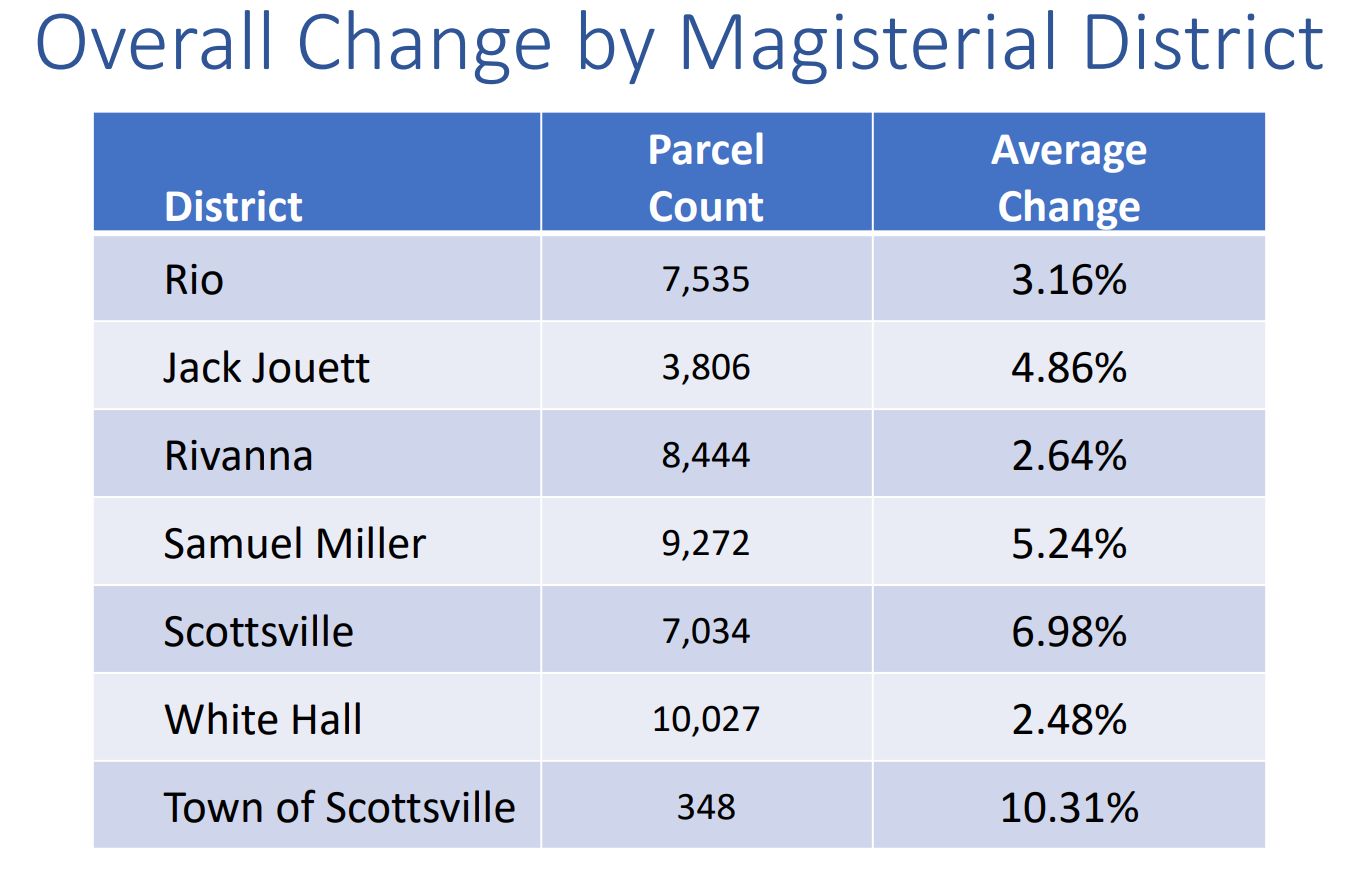
Different sections of the county performed differently with the 341 parcels in the Town of Scottsville having an overall average increase of 10.31 percent, followed by 6.89 percent for the Scottsville Magisterial District which has 7,034 parcels.
At the low end, property assessments were up an average of 2.48 percent in the 10,027 parcels that make up the White Hall District.
The figures in the middle are:
- 2.64 percent for the 8,444 parcels in the Rivanna District
- 3.16 percent for the 7,535 parcels of the Rio District
- 4.86 percent for the 3,806 parcels in the Jack Jouett District
- 5.24 percent for the 9,272 parcels in the Samuel Miller District.
The assessment data can be looked at in different ways. For instance, properties are all classified by the state of Virginia under different categories such as Urban Residential.
“The Urban Residential at the top is any property that has county water and sewer,” Lynch said.
The 23,093 parcels in that classification increased an average of 4.49 percent. Here are some more:
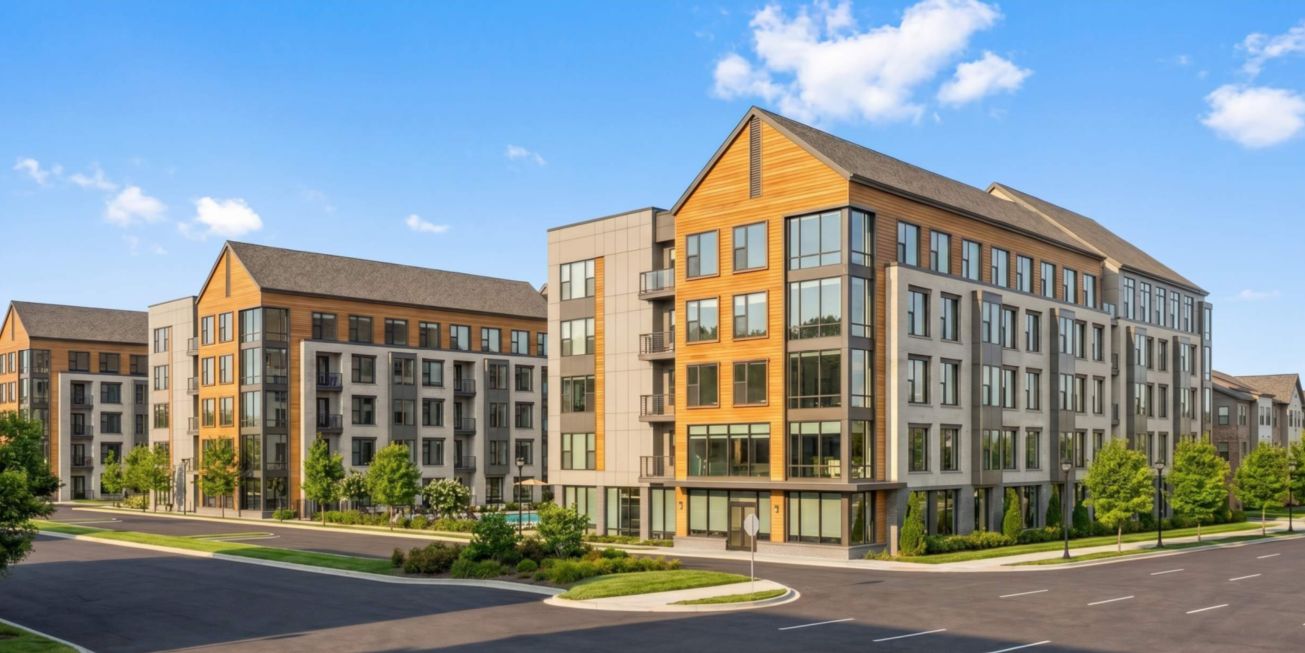
- The 226 parcels designated as Apartments increased an average of 5.63 percent.
- The 1,387 commercial / industrial properties increased an average of 3.09 percent.
- The 3,382 rural properties between 20 acres and 99.99 acres increased an average of 2.41 percent.
- The 840 rural parcels over 100 acres increased by an average of 1.1 percent.
Lynch cautioned that these are averages and do not represent everyone’s experience.
“It’s really easy to talk about averages with any one of our groups but the actual experience can vary greatly,” Lynch said.
The Office of the Assessor also runs the county’s land use taxation program.
“The whole point of the land use program is to maintain uses, qualified uses on a property, and qualified for a lower land use tax assessment and protect that land from being developed,” Lynch said.
Lynch said 2023 was a revalidation year, which meant participants had to demonstrate they still qualified. The number of parcels in the program dropped from 3,938 to 3,744.
“Now some of this will reapply and they’ll get back in the program as long as their use has continued,” Lynch said. “The revalidation process is just kind of a step and then a reapplication will cause them to go back under. Some of those have fallen out and the revalidation just brought it to our attention.”
Revalidation happens every two years.
The overall amount of deferred real property taxes for 2024 still increased to $14 million. But, in 2023, 139 parcels had to pay a roll back tax yielding $1,222,463 for the county.
Tax bills are to be sent out on January 26, which happens to be today.
“When you receive your notice and you see your value, give us a call and we can explain the process to you especially as it relates directly to your property,” Lynch said. “Your property and your neighborhood.”
Lynch said some of these calls may result in a formal review. Requests must be made by February 28. Property owners have until March 30 to appeal to the Board of Equalization if they are not satisfied. Those public hearings begin in the late spring.
Before you go: The time to write and research of this article is covered by paid subscribers to Charlottesville Community Engagement. In fact, this particular installment comes from the January 26, 2024 edition of the newsletter and podcast. To ensure this research can be sustained, please consider becoming a paid subscriber or contributing monthly through Patreon.
Discover more from Information Charlottesville
Subscribe to get the latest posts sent to your email.