Growth in the urbanized portions of Albemarle County and Charlottesville depends on the amount of treated drinking water that can be provided and the amount of wastewater that can be processed. That planning could become more complicated if the Commonwealth of Virginia follows through an initiative to require more regional cooperation within watersheds.
For Albemarle and Charlottesville, the Rivanna Water and Sewer Authority is responsible for both services and the latter requires the maintenance of several waterways and pipelines. The Board of Directors got a series of updates at their meeting on August 25, 2024.
“As we all know, we have a series of reservoirs that we manage for our water sources and then we have a river intake on the North Rivanna River on the north side of the county,” said David Tungate, RWSA’s director of operations.
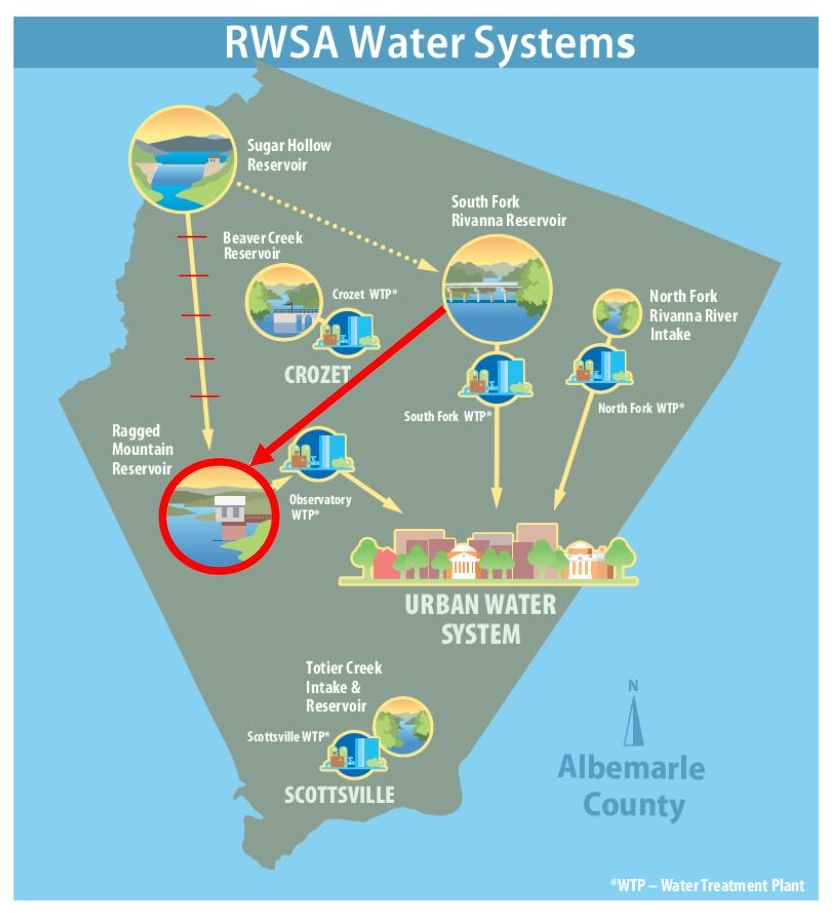
The Ragged Mountain Reservoir, the South Fork Rivanna Reservoir, and the Sugar Hollow Reservoir are all on land owned by the City of Charlottesville and water from there goes to both city and Albemarle customers. Beaver Creek Reservoir provides water for Crozet and Totier Creek Reservoir provides water for the Town of Scottsville.

A reservoir is a biological ecosystem and tests are conducted throughout the year to assess the environmental health of each waterway.
“Our goal is to collect data to better understand the biological processes in our reservoirs to make better water treatment plant decisions,” Tungate said. “How we run the plants, how we treat the water.”
Albemarle Supervisor Ann Mallek is the county’s representative on the RWSA. She said there has been an issue with landowners on reservoirs who completely clear the landscape.
“Which I know is not legal and I think it takes someone stronger than county parks,” Mallek said.
“It’s a zoning violation of your water protection ordinance because there’s a setback from all the public reservoirs of some width,” said Bill Mawyer, the RWSA’s executive director. “And that’s part of our reservoir management program is when we ride around in the boat, we’re looking to see who is clearing down to the water’s edge but then we notify the county because it’s a county ordinance.”
Vegetated buffers can reduce pollutants and sediment by making it harder for them to flow into a waterway. Tungate said the RWSA does tell Dominion not to apply herbicide on easements they have within 50 feet of the reservoir.
The RWSA Board also got a snapshot on operations at the six treatment plants which take water from the various sources. In addition to the five urban reservoirs, there’s a much smaller treatment plant that takes in groundwater for an area in Red Hill in southern Albemarle. Tungate said this serves a dozen homes and a public school.

The South Rivanna Water Treatment Facility is staffed 24 hours a day, seven days a week because it is considered a Class 1 facility under Virginia regulations.
“If you’re drinking water in the urban system it’s because someone is working at South Rivanna right now,” Tungate said. “Easter, Christmas, all holidays, someone is working there.”
Crozet is a Class 2 facility and Scottsville is a Class 3 facility given their lower volumes.
“And then the Red Hill facility because it is groundwater and doesn’t have much treatment, the rules require someone to check on it once a day,” Tungate said.
Tungate said the Red Hill treatment plant is still monitored constantly using automated systems.
RWSA needs a new water permit
The ability to draw water and treat it for customers comes through the Virginia Department of Environmental Quality as well as the U.S. Army Corps of Engineers. One of the items these regulators look at is how much water ends up being added back to the watershed in streams.
The RWSA’s current permit was approved by the DEQ in 2011 and expired in February 2023.
“And you’re required to submit a pre application prior to that date and we did in 2021,” said Jennifer Whitaker, the RWSA’s chief engineer. “Due to staffing shortages at DEQ, they have still not completely reviewed and turned around our permit.”
Whitaker said DEQ issued a continuance in 2022 which means the RWSA is in compliance. However, the DEQ is expecting a new application from the agency this fall. This procedural requirement comes after the RWSA has built a new dam at Ragged Mountain Reservoir to expand the pool, but before work begins to build a nine mile pipeline to connect it with the South Fork Rivanna Reservoir.
“Generally if you’re just renewing, I don’t believe it’s such an onerous process, but because we are still constructing as well as withdrawing water, we still have components of the Community Water Supply Plan that we are constructing, there is more scrutiny to the permit process,” Whitaker said.
Crozet may run out of water to support growth by 2045
That does not include the Crozet water system, which comes from Beaver Creek.
“The reservoir, Beaver Creek Dam is what we call it, it’s actually called the Garnett Dam I believe,” Whitaker said. “It was constructed in 1963. It’s been the water supply for Crozet since then.”
Whitaker said new dam safety regulations that went into effect in 2011 and that upgraded Beaver Creek’s dam to a “high hazard dam” which led to an analysis of the Crozet water system.
“So we’ve been having conversations with the DEQ staff since 2017, so thinking we fully understood all of the requirements, we submitted our permit in 2022 and earlier this year we received draft permit language,” Whitaker said.
Whitaker said there were some comments that the RWSA did not expect, such as how the DEQ will only allow this permit to consider the first 15 years of demand rather than the 50-year planning horizon the agency usually requests. She explained what one practical effect might be.
“The state is most likely going to require more water going downstream than we’ve understood in 2017 through 2022 and what that means is that we are likely going to need additional water supply beyond 2045,” Whitaker said.
Whitaker said this alters the RWSA’s perception that there was enough water supply to support Crozet through 2070, but she said the process is still ongoing.
Regional planning in the TJPDC area?
Virginia’s current mechanism for approving municipal water supply systems dates back to the drought of 2002 that resulted in DEQ having the authority to require communities to have a plan.
“Localities were required to submit a water supply plan and there were 48 submitted by 2008, ten of which were what they called local plans and 38 were regional plans,” Mawyer said.
In recent years, the process has been changed through action of the General Assembly. Mawyer said the intent is to encourage more collaboration across jurisdictions.
“Albemarle has been grouped with Greene, Louisa, Fluvanna, and Buckingham counties as our new water supply planning area,” Mawyer said.

These new boundaries will come up for public comment later this month.
The new rules introduce an interesting layer of potential governmental interaction at a time when the James River Water Authority has broken ground on a new waterline to serve Zion Crossroads and as Greene County struggles to identify ways to pay for a reservoir permitted by the DEQ.
Mawyer said he is making efforts to reach out to all of the various players.
Another factor for the future across the nation is a changing set of rules that could lead to consolidation. The United States Environmental Protection Agency now has authority to force smaller water treatment systems to be restructured to meet enhanced water quality requirements.
Mallek said she was concerned that well-established entities like RWSA will have to pay for some of the soft costs of regional cooperation outside of existing partnership. She is also the co-chair of a local government council that advises the EPA.
“There’s been a huge amount of pushback at the EPA, the local government planning, when this restructuring committee began because yes on one hand there are communities who lack expertise,” Mallek said. “They have 3,000 customers and don’t have a chance at any cost to do this, but they’re also fearful because the feds use the term consolidation as if they’re going to be forced to be bought up by the worse case scenario, a private company who will take them to the cleaners big time.”
Mallek asked the RWSA Board to consider directing Mawyer to notify Greene County that there will be no capacity to help them out until 2034 when the Community Water Supply Plan.
City Manager Sam Sanders asked for clarity that there was no mandate yet for regions to build together, but only to plan together. Mawyer said that was the case and there has so far only been an informal inquiry from Greene.
“Under the sentiment expressed, we should try to keep this as official as we possibly can and that we would be responding to a request and without a request I think they can look at our minutes and understand sentiments being expressed about what the concerns might be,” Sanders said.
Stay tuned for more information as it develops.
Before you go: The time to write and research of this article is covered by paid subscribers to Charlottesville Community Engagement. In fact, this particular installment is from the September 4, 2024 edition of the newsletter. To ensure this research can be sustained, please consider becoming a paid subscriber or contributing monthly through Patreon.
Discover more from Information Charlottesville
Subscribe to get the latest posts sent to your email.